
Are You a Socialist?
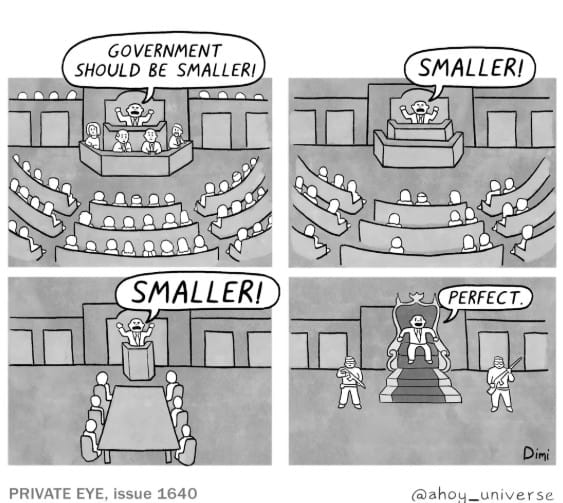
Not only am I a socialist, apparently I always have been, since I believe government exists to provide betterment for people in ways they can't do individually.
(originally published in CEBV CAN on Sept. 21, 2025)

I've been pondering an explanation of democratic socialism for a long time. Sometimes procrastination pays off, since I just read a column that does a better job than I could, so I'm happily using some excerpts here.
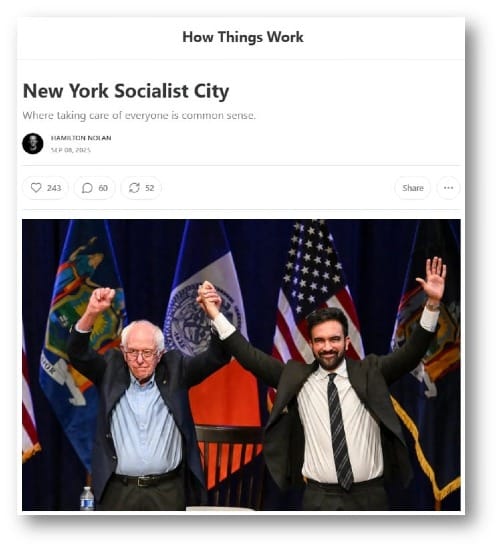
"The most common usage of the word “socialism” in mainstream political discourse is as a slur, something that Republicans hurl at Democrats, who respond by trying to run in the opposite direction," writes Hamilton Nolan in New York Socialist City.
Not only am I a socialist, apparently I always have been, since I believe government exists to provide betterment for people in ways they can't do individually. Or, as Hamilton Nolan defines socialism in the American context, "public services for the public good." Like the stuff below:

"When you look at it this way, you may notice that socialism is pretty popular!" writes Nolan. "People tend to love the socialist things that already exist as much as they claim to despise the idea of any socialist thing that does not yet exist. If the general public were just a little less susceptible to red-baiting, they could have a ton of nice things. Our unstated national agreement is to all stop calling the socialist parts of our country “socialist” as soon as they are established."
It seems that some people believe solely in the military defense part, and many of them are in positions of power! They feel that providing services to people amounts to coddling, and if people just pulled themselves up by their bootstraps, they could afford it all. And what about the people who work 2 (or 5) jobs and still struggle to afford groceries or a home? If we don't see them, they don't exist.
This Dickensian view is somehow not appealing to the vast majority of Americans, who may still be failing to draw the connection between "small government" and "a government that does nothing for you."
Social benefits aren't free. They are paid for by a taxation system predicated on the belief that when we pay, we benefit. Those who can afford to pay more, pay more. The wealthy call that "income redistribution," utterly refusing to recognize that their tax breaks, shelters, and corporate subsidies are redistributing wealth from the poor to the rich, since those without such tax havens pay more. If you question the breadth of this upward wealth redistribution, check out Matthew Desmond's Poverty, by America.
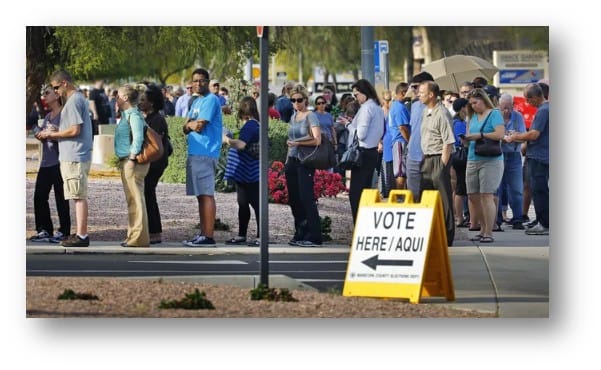
In Arizona, this is directly relevant to Arizona's revenue system. In our infinite wisdom, Arizona voters enacted Prop 108 in 1992, requiring that both legislative chambers approve any tax increases by a 2/3 majority. Reducing revenue, though, just takes a simple majority. In 2024, Arizonans allergic to taxation passed a ballot resolution requiring a 60% supermajority public vote for any ballot measure that raises revenue. Not coincidentally, Arizona is 5th lowest in the country in per capita spending, and Washington State, with roughly the same population, has a budget 2.5 times the size of Arizona's.
Our state is at a tipping point. Two-thirds of our legislators can't agree that water is wet, and the Republican majority has steadily hacked away at income taxes while increasing special interest tax breaks by $18 billion in the last eight years — an increase of 250%. Corporate tax revenues are declining.
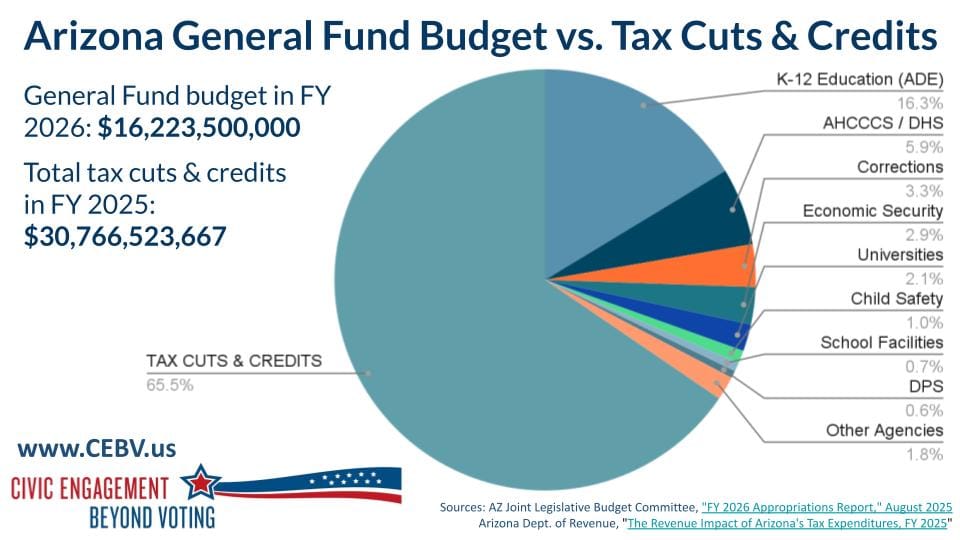
Our state disproportionately depends on sales taxes and federal payments. The former is regressive and impacts lower income people more; the latter will be reduced due to the One Big Crappy Bill. For some light reading, check out the Joint Legislative Budget Committee's January 2026 Monthly Fiscal Highlights as well as the JLBC's report on projected Federal Budget Reconciliation Bill—State Impact. Bottom line: conforming Arizona's taxes to the new federal policies will cost the state $1.45 billion over the next 4 years. This is currently the subject of a battle of chicken between the Republican-controlled legislature and the governor (Gov. Hobbs prefers partial conformity by excluding corporate and high-income tax breaks).
It's not for nothing that we say budgets are moral documents. I can't help concluding that our state (and nation) are marching resolutely away from our needs and expectations as a society. Even modest proposals from a New York City mayoral candidate that aim directly at people's needs are seen as shocking and — yes — socialist.
Well, count me in.
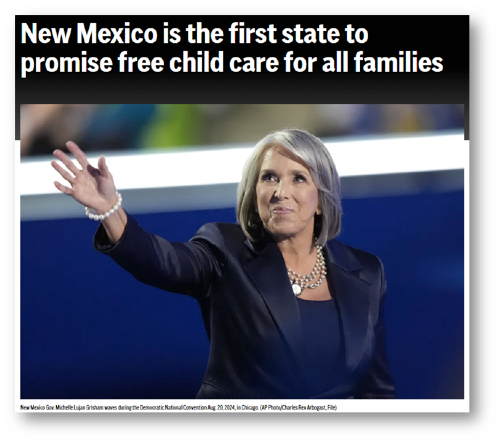
New Mexico Gov. Michelle Lujan Grisham announced her plans for the state to underwrite child care, saying she wants to leverage a financial windfall from oil and gas production to help more parents by removing the state’s income eligibility limit starting Nov. 1.
Rules for the program are being hashed out and lawmakers still have to approve funding. The latest initiative expands on previous early childhood education investments by extending access to another 12,000 children and making low-interest loans available to spur construction of new child care centers as demands surge.
Lujan Grisham says it’s life-changing for parents to have free child care, since it means more money can be spent on utilities and groceries.
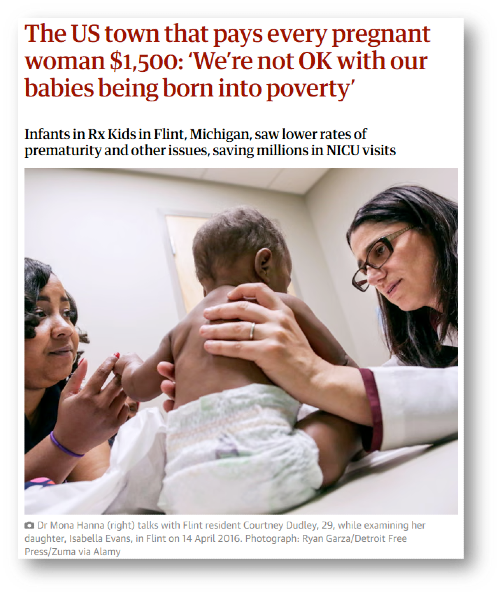
When Angela Sintery first learned about Rx Kids, a program for new mothers in her home town of Flint, Michigan, she thought someone must be trying to scam her. The program promised $1,500 for all expectant mothers during pregnancy and $500 per month for the first year of their infant’s life. All Sintery had to do was upload a copy of her ultrasound and ID.
This week, researchers at Michigan State University published two studies formalizing what Sintery felt. Their results showed that Rx Kids lowered rates of maternal postpartum depression, stabilized families’ housing and improved infant outcomes – saving millions of dollars in NICU spending.
“Rx Kids was born out of the same spirit that a community came together and said: ‘We’re not OK with poisoned water’ and later would say ‘we’re not OK with our babies being born into poverty,’” said pediatrician Mona Hanna, the same physician who a decade ago discovered lead levels in local children’s blood had risen dangerously after the city switched its water supply to the Flint River.
Rx Kids was founded with the support of the non-profit GiveDirectly, a US-based group focused on ending extreme poverty through unconditional cash transfers. The approach also has helped Rx Kids rebuild trust in the city’s institutions, said Laura Keen, GiveDirectly's US program director, especially after the water crisis. The program has since expanded to 11 communities across Michigan, and is near to launching in six others.
Comments ()