
June 15, 2026
Our yearly budget and ballot referral recap. Buckle up, this one's a doozy. On to election season.
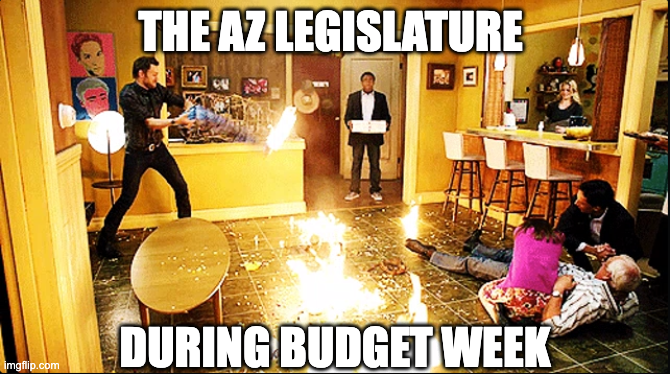
The Arizona Legislature has finally adjourned sine die (a term meaning they've gone home until next January), but not without doing a lot of damage on their way out the door. This week, our Republican-controlled legislature reached the "petulant toddlers throwing crayons" phase — banning teachers and parents from the Senate, screaming and threatening physical violence, and shutting down the truth at every opportunity by wielding their majority power as a cudgel.
Republicans calling points of order every time Democrats remind them of the many times over prove FRAUD, WASTE and ABUSE in Arizona’s out-of-control ESA program.
— Arizona House Democrats (@AZHouseDems) June 13, 2026
Calling a "point of order" allows majority-created rules to be wielded as weapons to shut down debate, in the name of red herrings like "decorum."
Typically, the final days of session feature the resurrection of some long-stalled "zombie bills" we all hoped had died earlier in the year. Sine Die 2026, though, was a doozy. Republican lawmakers tried to craft a shady backroom deal to kill the Protect Education voucher reform initiative, threatening and twisting arms in an attempt to force Democrats and public education advocates to bend. When Senate and House Democrats stood united and refused, the deal fell apart. Republicans retaliated by shoving through three anti-education ballot measures as punishment, even creating one entirely new measure without any public input and voting it onto the ballot in the middle of the night while voters slept. This level of sleazy, underhanded abuse is unprecedented, even for state lawmakers who have long been accustomed to wielding nearly unchecked power.
 Howard Fischer
This edition of the Weekly is a long read. Grab your favorite beverage and settle in for all the details, or scan it section by section for your favorite topic. Any way you slice it, as Sarah Liguori (D-5) puts it so beautifully in the short video just below, our work is cut out for us from now until November and beyond. Dig in!

⏳ If you have 2 minutes: Forward this email to anyone you know who cares about Arizona's fiscal state, ballot referrals, or what to watch for in this year’s elections.
⏰ If you have 5 minutes: Ask Gov. Hobbs to veto the two most dangerous bills on her desk, HB4177 and HB2133. See the "Spotlight" section for more, then contact her office at 602-542-4331 or engage@az.gov.
⏰⏰ If you have 15 minutes: Grab a Protect Education petition and collect some signatures! Only 2 weeks remain to collect and turn in. Voters are about to take matters into our own hands and finally create some regulations for this rampant, unaccountable program. The lawmakers and special interests who profit off it are terrified, which means we're about to accomplish something truly important. Be a part of it. Add your signature if you haven't already, then request a petition (or grab one at a depot near you) to get friends and family to sign.
⏰⏰⏰ If you have 30 minutes: Write to one or more lawmakers to tell them you're paying attention and will remember their harmful votes. See the "Hall of Shame" section for more.
⏰⏰⏰⏰ If you have 60 minutes: Join us on Zoom for our final regular CEBV Happy Hour conversation of the year, this Sunday at 4 PM. (We'll host a comprehensive Session Roundup soon.) This week's Happy Hour will be packed with political analysis, conversation and community. We're looking forward to seeing you!

As you've almost certainly heard by now, Gov. Hobbs and Republican legislative leaders negotiated to pass a "bipartisan" compromise budget. Here's a rundown of what's in it, what isn't, and the bottom line.
Splitting the difference. This budget totals $300 million more than the Republican-only one that Hobbs vetoed in May, but $800 million less than Hobbs' executive proposal from January. Democrats say they were able to protect many agencies from the across-the-board cuts Republicans wanted, saving $470 million from the chopping block and allowing flat 2.5% cuts in some areas only. Last week, we called on lawmakers to leverage the new revenue numbers from May 26 to prevent large cuts — for the most part, that's exactly what they did.
Senate Majority Leader @JohnKavanagh_AZ tells me the two sides were essentially able to split the difference because of new revenue forecasts. https://t.co/2OBA5s7FFS
— Craig Harris (@CraigHarrisNews) June 9, 2026
Tax conformity. Arizona will fully conform to the massive tax cuts in HR1 for tax year 2025 only. This is expensive, but means no one will have to refile their taxes. The state will then shift to a more curated (but still expensive) approach. Both sides are claiming victory for their own strategy, but our position is that there are few wins to be had for anyone here. Many voters fail to understand that tax cuts and service cuts are one and the same: tax cuts mean less revenue for the state and thus more cuts to the services Arizonans depend on. Supply-side (i.e. "trickle-down") Republicans would have us believe tax cuts will pay for themselves, but that Reagan-era fallacy has been disproven again and again. The direct revenue loss from a tax cut almost always exceeds any indirect gain. That means something has to give, and that "something" is services like libraries, schools, roads, community colleges, and health care. It's politically popular to say you cut people's taxes, but when you ask about cutting programs, their opinion shifts to overwhelming opposition.
Democrats say government has shrunk too much, and that tax cuts in Arizona have left the state without enough revenue to provide for its citizens. "Nobody's going to say 'Yes, I want big government,'" said Stacey Travers (D-12) while explaining her budget vote. "But we also need to be pragmatic and realistic, right? There are folks that need assistance trying to navigate through services or through government, and we need to be able to support that with a governmental infrastructure." A government that's cut to the bone will struggle to provide the services Arizonans want and need. We fear a duplication of the cycle we've seen in public education: budget cuts that lead to large class sizes and fewer teachers, then cries of "failing schools" followed by even more punitive budget cuts, and, ultimately, the ushering in of for-profit "solutions" that make money for their creators while regular people lose.
That said, going forward, most of the pieces of the HR1 targeted to large corporations and the ultra-wealthy have been stripped from the deal beginning in tax year 2026 (this calendar year). Arizona won't adopt the business depreciation deduction that allows large corporations to write off 100% of their equipment purchases in the first year, the Roth IRA deduction that gives wealthy families with kids $1,000 of "free money," and the pricey SALT deduction that allows itemizing taxpayers to deduct state and local taxes from federal income. Instead, lawmakers agreed on cuts that are targeted more toward the middle class, such as a higher exemption for seniors, a removal of interest on new car loans, an increased dependent credit, and a deduction for dependent child care expenses. They also included a new $150 million for reinvestment in public infrastructure for local governments.
Data centers. Progressives fought for and won a 3-year moratorium on Arizona's tax break for data centers without extending the tax break's 2033 expiration date. This isn't the full repeal they'd wanted, and it's not retroactive, but it's the most aggressive state-level move against this industry so far nationwide, and it will save our state at least $57 million over three years. The tax credit moratorium is an important win not because of the cost savings (which is modest in comparison to the overall size of the budget), but because it completely shifts the conversation: when the moratorium is up, lawmakers' next discussion will be over whether to restart these damaging policies instead of fighting to stop them. Republicans also failed to push through the small modular nuclear reactors they'd been fighting for to power energy-greedy data centers, as well as the by-right industrial zoning they'd wanted, which would have allowed reactors near data centers without local oversight.
SNAP and Medicaid. After fighting all session to push through massive cuts to these programs, Republicans walked away with almost none of them. The budget invests $21 million more in staff to help Arizona comply with new draconian federal changes, and there's no new quarterly review of recipients' eligibility. This is projected to help to keep 40,000 people from losing their benefits. On paper, the budget toughens verification checks for SNAP and Medicaid, but the changes expire in one year, and insiders tell us they're written to change very little operationally. Notably, there's also a $3 million appropriation for food banks, which have seen a surge in demand in the wake of federal cuts.
Cuts to higher education. This budget cuts $16 million from state university funding, along with another $16.3 million from the Arizona Promise Program for low-income students. Insiders say the cuts were negotiated with universities to do as little damage as possible (for example, universities will be allowed to trim money from bloated, ideologically biased Koch "freedom schools"), and the reductions will last for one year only. This is particularly important because Republicans, who have made no secret of their long-running hatred for public universities, wanted to slash twice as much. Still, some Democrats cited the cuts as their reason to vote no on the budget.
The glaring omissions. Both sides acknowledge this budget isn't perfect, and that's true; it's missing a lot. Chief atop that list is a renewal of Prop 123, the voter-approved $300 million measure (which expired last year) that drew from state land trust interest to fund public schools. Despite Hobbs walking away from negotiations earlier in session because Republicans refused to negotiate a renewal, Arizona's public schools will go one more year without this funding stream. Many may have forgotten that Prop 123 was originally negotiated as a compromise with former Gov. Doug Ducey to settle litigation over years of unlawful underfunding of public schools. It feels like Groundhog Day all over again.
The amount of money -- $350 million -- that ESA parents have stockpiled for their kids future use (college, backyard playground, trips to Disneyland)
— Craig Harris (@CraigHarrisNews) June 10, 2026
is more than what would have been generated for public education had @GOP lawmakers asked voters to approve Prop 123. https://t.co/9FDbejeOQ5
The sacred cow. Another glaring omission is that, for the fourth year in a row, Republicans have utterly refused to include even the barest ESA voucher reform. The dirty tricks they played in the final hours of session are proof that, despite the thorough documentation of rampant waste, fraud and abuse, they will stop at nothing to protect this sacred cow.
The private ed push continues. Despite acknowledgment in Aug by AZ GOP Chair that voucher loopholes enabled wasteful spending, AZ Republicans are poised to hold the line. Again. No new restrictions and no income cap, academic testing , or fingerprint registration requirements. pic.twitter.com/FeojZhekJG
— JOE DANA (@JoeDanaReports) June 11, 2026
Court-ordered prison reform. The budget only invests half of the amount needed to comply with a federal court order to hire additional staffing to reach the minimum humane level of care for prisoners incarcerated by the state. This class action litigation has been ongoing for nearly 14 years, and Arizona fails to comply year after year as our Republican-run legislature kicks the can down the road and hopes the problem will magically disappear. Corene Kendrick, deputy director for the American Civil Liberties Union National Prison Project, puts the problem succinctly: "Thousands of incarcerated people are at serious risk of harm and are continuing to experience unnecessary and preventable injuries and deaths due to the failure to have an adequate number of health care staff in the prisons across the state."
The myth of "government waste and bloat." Agencies aren’t being forced to take cuts because they were overspending. They're shouldering misplaced blame for the massive budget holes created by out-of-control ESA vouchers and outsized Ducey-era tax cuts. Leaving the $1.1 billion voucher program untouched and making cuts elsewhere plays right into the lie that mythical "government inefficiencies" are eating up our resources. There's an old joke about a woman searching for her lost diamond ring under a streetlight: a passer-by wanted to help and asked where exactly she dropped it, to which the woman replied, "Oh, I dropped it by the hedge over there, but the light is better here." This is the same story. Our lawmakers are looking for inefficiencies in the wrong places, and regular people are paying the price.
The bottom line: our state is afflicted with a far-right, insensible legislative majority that attacks basic governance at every turn. If we want a better budget, we need better lawmakers. That's all there is to it. Republicans have had control of the Arizona state legislature since the 1950s; it's time to try something different. It's a good thing every seat at the Capitol will be on the ballot this year.

In a last-minute flurry of attacks, state lawmakers voted this week to place seven additional measures on our November ballots. Nearly all of these passed along party lines, with only Republicans in support, and every single one is harmful.
 Camryn Sanchez and Wayne Schutsky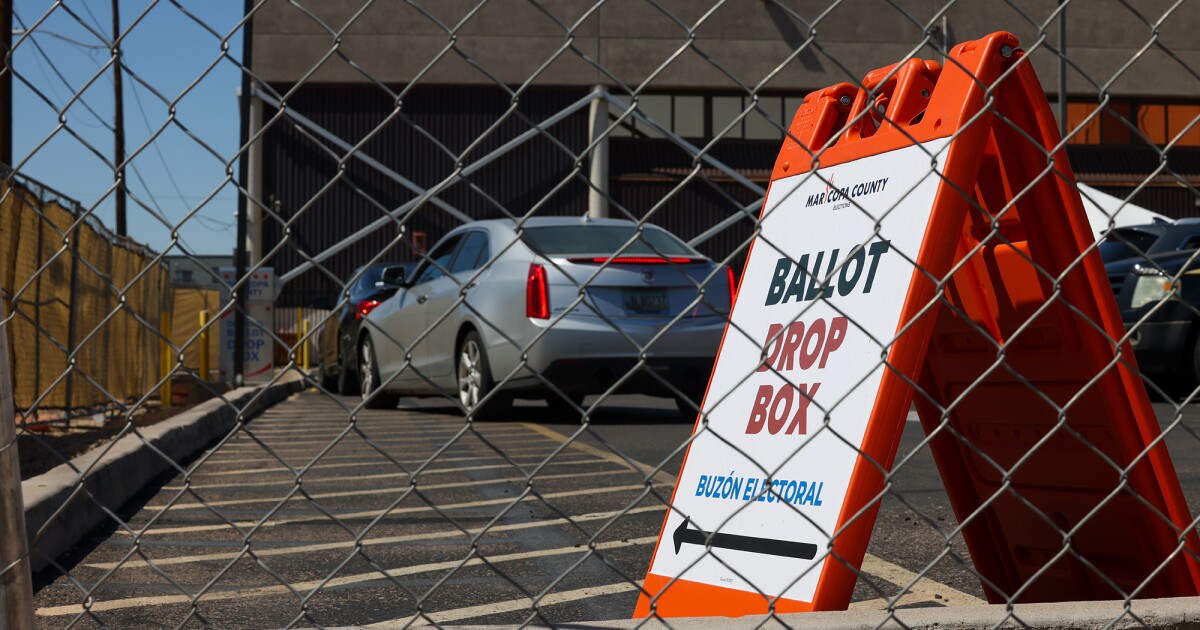
Lawmakers have now passed a total of 10 legislative referrals over the past two years, all of which will land on our November 2026 ballots. Don't get too attached to the bill numbers we share here; as our ballots are prepared, the Secretary of State will be assigning all of these measures brand-new proposition numbers.
It's likely those ballots will be just as long and unwieldy as they were last cycle — but CEBV is here to help. Read through the descriptions below, then stay tuned for our in-depth Ballot Guide, as well as several online ballot measure presentations with high-level analysis, talking points and messaging advice. Look for all our online events on Mobilize here, and be sure to subscribe to our emails to get all the updates, links, guides, and news. We'll release these in September, before general election ballots drop on October 7.
Defunding Clean Elections. SCR1004 (Rogers, R-7) would ask voters to ban cities across Arizona from using photo radar unless a city votes every 10 years to approve it. Traffic radar reduces crashes and injuries by 35%; repealing it means more dangerous roads and more collisions. Far-right extremists' excuse for doing this is that they call photo radar “totalitarianism” and “mass surveillance,” but the real reason is that it's a back-door way to defund the voter-created Citizens Clean Elections Commission, which they and their dark-money backers have long hated. In Arizona, photo radar fines levy a mandatory 10% surcharge for Clean Elections, which provides public funding to candidates who agree to forgo private or special-interest money. OPPOSE.
Early voting attack. HCR2001 (Kolodin, R-3) is purposely designed to kill Arizona's early voting system by requiring all voters — even those voting mail ballots — to somehow show government-issued ID before casting a ballot. The bill doesn't say how or when early voters must provide this ID. Would we have to include a photocopy of our ID with their early ballot? Who knows! Do we write our driver license number on our ballot, violating voter privacy? That wouldn't take place "before" we cast our ballot, so probably not! Worse, this bill now allows early and mail voting only if it's "reasonably connected to a legitimate state interest," vague language that will give election deniers broad grounds to sue at significant public expense. OPPOSE.
Persecuting vulnerable kids. HCR2003 (Bliss, R-1) would ostracize the tiny minority of trans girls in Arizona by asking voters to exclude them from girls' youth sports leagues and facilities, overriding any parental permission the girls have been given to participate. Anyone could sue if they suspect a trans girl was included. This is a blanket ban that treats kindergarteners the same as college athletes, and bowling the same as football. Our students deserve rules that promote sports fairness, taking age and sports type into consideration, not blanket bans like this one. OPPOSE.
Attack on school funding. HCR2007 (Gress, R-4) is designed to micromanage and cripple public district schools (but not charter or private ESA voucher-funded schools). The measure asks voters to force public schools to spend at least 60% of their funding on “direct instructional expenses” or have the difference withheld by the state. This is an impossible benchmark that schools have not met at any point since 2003 when the Auditor General’s Office began monitoring the number. Why? "Direct instructional expenses" only covers teachers, some aides, instructional supplies, field trips and athletics — a narrow definition that doesn’t address all the other pieces required to make a kid’s school day work. This excludes librarians, custodians, counselors, teacher training, technology, building maintenance and repair, groundskeeping, security, accounting and payroll, air conditioning, insurance, food service, buses, and all the clerical staff that make any school (or large corporation) run. Republicans love to use "top-heavy administrative spending" as a false flag to aggressively undermine support for public schools. In fact, Arizona has among the lowest administrative costs in the nation. OPPOSE.
Attack on teacher's unions. HCR2040 (Olson, R-10) aims to legislate away teacher's unions by creating a slew of new limits on how educators can collectively organize and bargain, something which creates better working conditions for teachers and better learning conditions for students. The measure would ban teachers from deducting their union dues directly through payroll (which only happens at teachers' requests) in a blatant attempt to shrink membership. It would also prohibit districts from using any public resources to support labor organizations, which means school facilities couldn’t be used to host union meetings — even when rented like other clubs or organizations — or even allow union members to have a presence at events like new teacher orientations. Incredibly, Republican lawmakers stated they were advancing the measure to keep public monies from being used to support private organizations — right after they'd passed HCR2048 (see below). OPPOSE.
Ideological censorship. HCR2044 (Montenegro, R-29) asks voters to enshrine racism in the state Constitution. This culture-war-driven measure would block teachers from discussing accurate history, censor certain content from being taught in schools, and ban trainings on how to support LGBTQ+ staff and students. It would also allow the legislature to "prescribe related practices or concepts" to ban — in other words, to forbid any conceivable notion that conspiracy theorists propagate, and claim they already have voter approval to do it. OPPOSE.
Do you appreciate the many hours of work it takes to produce a resource like this every week? Become a paid subscriber and help keep us going:
⚠️ New: Voucher ballot killer. HCR2048 (Way, R-15) is a last-minute striker that asks voters to constitutionally override the Protect Ed initiative, along with any future ESA voucher reforms. This Trojan-horse measure uses military families as political pawns to enshrine vouchers in the state Constitution, forever killing any reform that would return funds to the state. If voters approve both this and Protect Ed, Protect Ed would fail — even if it gets more votes — because Protect Ed is a statutory law and this constitutional amendment would override it. When asked if Republicans were running this measure because they failed to reach a deal to kick Protect Ed off the ballot, John Kavanagh (R-3) flat-out admitted, “That's the reason why we're running this.” OPPOSE.

In the wee hours of the last day of session, lawmakers passed these two incredibly harmful bills. Gov. Hobbs is reportedly set to sign them. Contact her office NOW at 602-542-4331 or engage@az.gov and make it clear we expect a veto.
HB4117, sponsored by Teresa Martinez (R-16), would make it a felony to "disturb religious activity," even on street corners or in public parks. This would give bad actors like the Westboro Baptist Church new legal protections as they create disruptions at Pride parades, family planning clinics and funerals, and potentially criminalize any Arizonans who push back.
 Howard Fischer
HB4117 is being billed as a fix to growing antisemitism and disturbances at synagogues, but its vague, overbroad language creates new dangers for our First Amendment rights. The bill grants new rights to disruptive protesters at abortion clinics who claim religious liberty, puts clinic volunteers at risk of felony charges if they interact with protesters, and would even allow a street preacher to shut down Pride. Even our most stereotypically clueless legislators can see that's a terrible idea:
The true goal of HB4117 appears to be punitive and politically motivated. It's being dubbed "the Don Lemon bill," as state legislatures nationwide are passing similar crackdowns in the wake of the shocking federal arrest of journalist Don Lemon. Federal officials, in what is broadly seen as an unconstitutional overreach, arrested Lemon as he reported on an anti-ICE protest that disrupted a church service.
HB2133 (Kupper, R-25) is a Project 2025-inspired bill that would drive political censorship by requiring the consent of people depicted in digitally created content if politicians decide the material is “harmful to children.” Anyone who posts a cartoon or AI-generated video featuring a depiction of a real person would need that person’s consent. This will lead to broad censorship of online content; experts warn it could result in streaming services like Netflix refusing to serve Arizona altogether. The bill would also demonize LGBTQ+ people by conflating “transgender ideology” with pornography. Gov. Hobbs is actively pushing to sign the bill, which is being sold as an "anti-revenge porn" measure.

One of our most important tasks is to hold our allies accountable. Though these lawmakers did good work this week, they also voted to support these very harmful bills, which in some cases would not have passed without their support. We ask them to heed and do better.
This week, we're disappointed in:
👎 Lupe Contreras (D-22), 👎 Rosanna Gabaldon (D-21), 👎 Theresa Hatathlie (D-6), 👎 Alma Hernandez (D-20), 👎 Consuelo Hernandez (D-21), 👎 Sarah Liguori (D-5), 👎 Elda Luna-Najera (D-22), 👎 Analise Ortiz (D-24), 👎 Kiana Sears (D-9) and 👎 Priya Sundareshan (D-18) for voting YES on SB1624. This bill would institute a host of limits on photo radar, including capping the cost of tickets at $75. This is a back-door way to defund the voter-created Citizens Clean Elections Commission, which dark-money special interests have long hated. In Arizona, photo radar fines carry a mandatory 10% surcharge for Clean Elections, which provides public funding to candidates who agree to forgo private and special interest money — so slashing those fines would also slash Clean Elections' budget.
👎 Kiana Sears (D-9) and 👎 Kevin Volk (D-17) for voting YES on HB2003. This bill would drop the minimum age for getting a driver's permit to 15, which flies in the face of safety standards. Teen drivers have crashes at nearly 4 times the rates of drivers ages 20+; lowering the age would increase both fatal crashes and accidents overall.
👎 Lydia Hernandez (D-24) and 👎 Kevin Volk (D-17) for voting YES on the final read of HB2133. This Project 2025-inspired bill creates politically motivated censorship and would demonize LGBTQ+ people in lockstep with Project 2025 by conflating “transgender ideology” with pornography. See the "Spotlight" section above for more.
👎 Consuelo Hernandez (D-21), and 👎 Lydia Hernandez (D-24) for voting YES on the final read of HB2140. This bill would allow Arizona government to invest in gold bullion, a volatile nightmare for our fiscal stability as the value of gold fluctuates with the market. Based on tinfoil-hat beliefs that government has conspired to cause a crisis by controlling our money.
👎 Consuelo Hernandez (D-21), 👎 Lydia Hernandez (D-24) and 👎 Myron Tsosie (D-6) for voting YES on the final read of HB2592. This bill would require every state agency to try to incorporate AI into its everyday operations, and would ban agencies from regulating its use in any way without the legislature's express permission. Blindly trusting AI in this way carries serious risk; we shouldn't be using it without robust oversight.
👎 Lydia Hernandez (D-24) for voting YES on the final read of HB2745. This bill would allow the legislature to arrest anyone who refuses to comply with a subpoena they issued — including another elected official — and physically haul them before a committee. The intent is to target Attorney General Kris Mayes; in 2024, some far-right legislators convened a pointless hearing to call for her impeachment, which she refused to attend.
👎 Lydia Hernandez (D-24) for voting YES on the final read of HB4056. This bill would ban anyone from charging a state lawmaker reasonable fees for fulfilling a public records request, in response to the Tolleson school district charging Matt Gress (R-4) the standard service rate for his massive 26,000-page request. Lawmakers can already obtain public records via official channels, making this bill a vindictive, unnecessary publicity stunt.
👎 Lupe Contreras (D-22) 👎 Alma Hernandez (D-20), 👎 Consuelo Hernandez (D-21), 👎 Lydia Hernandez (D-24), 👎 Elda Luna-Najera (D-22), 👎 Kiana Sears (D-9), and 👎 Kevin Volk (D-17) for voting YES on HB4117 this week. This bill attacks our First Amendment rights by making it a felony to "disturb religious activity," even on street corners or in public parks. This gives bad actors like the Westboro Baptist Church new legal protections when they create disruptions at Pride parades, family planning clinics and funerals, and potentially criminalizes any Arizonans who push back. See the "Spotlight" section for more.
Contact these lawmakers as follows:
▶️ Lupe Contreras • lcontreras@azleg.gov • 602-926-5284
▶️ Rosanna Gabaldon • rgabaldon@azleg.gov • 602-926-3424
▶️ Theresa Hatathlie • thatathlie@azleg.gov • 602-926-5160
▶️ Alma Hernandez • ahernandez@azleg.gov • 602-926-3136
▶️ Consuelo Hernandez • chernandez@azleg.gov • 602-926-3523
▶️ Lydia Hernandez • lhernandez@azleg.gov • 602-926-3553
▶️ Sarah Liguori • sliguori@azleg.gov • 602-926-3264
▶️ Elda Luna-Najera • eluna-najera@azleg.gov • 602-926-3881
▶️ Analise Ortiz • analise.ortiz@azleg.gov • 602-926-3633
▶️ Kiana Sears • ksears@azleg.gov • 602-926-3374
▶️ Priya Sundareshan • psundareshan@azleg.gov • 602-926-3437
▶️ Myron Tsosie • mtsosie@azleg.gov • 602-926-3157
▶️ Kevin Volk • kvolk@azleg.gov • 602-926-3498

2026 Timeline
Monday, June 22: Last day to register to vote in the July primary election
Wednesday, June 24: Early voting begins for the July 21 primary election
Tuesday, June 30: Last day to sign or turn in signatures for the Protect Ed voucher reform initiative
Saturday, Sept. 12: General effective date for 2026 legislation
Wednesday, Oct. 7: Early voting begins for the Nov. 3 general election
Committees & Contacts
Here's a handy list of lawmaker contact info, committee chairs and assignments.
CEBV Action Linktree
Want other ways to take action? Need to stay informed? Looking for our social media, inspiration, or self-care tips? Look no further than our Linktree.
Congratulations, you made it to the end! Please enjoy this lovely post, and its many replies, as a reminder of the kindness our society still possesses:


Comments ()