
May 11, 2026
Lawmakers on vacation. Let them eat retirement accounts. The nature of divided government.
Checked out. Your Arizona Legislature is closed for business! After the House sent its veto-bait budget to the governor, they voted along party lines, with only Republicans in support, to skip town until June 1. Despite getting a full month's paycheck, the House will only work one day in May. The Senate is following suit; they’ll reconvene Monday, but say they'll take the rest of the month off. There is no plan for what happens next.
The result we all expected. Hobbs promptly vetoed the partisan budget Republicans sent her just as she’d signaled she would, blasting the majority party for its selfish, “chaotic and dysfunctional Washington-style budgeting.”
It takes two sides to talk. Last week, we predicted Hobbs (a former social worker) would be the bigger person and reach out to reopen negotiations, and that’s exactly what happened. Both sides confirm she invited the House and Senate this past week to a budget meeting, and Hobbs herself told KTAR the two sides met Thursday. We’re glad to see Republican legislative leaders finally taking time out from playing blame games to put their big boy pants on and discuss grown-up issues. Finger-pointing might score you political points with your base, but it won’t get a budget passed.
Ignoring reality. That said, they still have a long way to go. Their “good faith” seat at the negotiating table still seems to be vacant, as Senate President Warren Petersen (R-14) said Hobbs shouldn’t expect negotiations to yield any major changes. “There may be a couple of things where she can provide an alternative… but you're not going to see a budget that's much different than the one you saw today,” he said. We’ll be blunt: that’s not reality. As the Arizona Agenda notes, “Last year, when Montenegro took control of the House, the performative budget standoff he orchestrated didn’t work out well for him.” They also correctly point out, “Negotiating with the governor is a thing you have to do when the governor’s signature is required.”

Know when to hold ‘em. The question is whether Hobbs will stand firm or fold. Republicans are banking she will do anything (as she has in previous years) to avoid a government shutdown, and indeed, she told KTAR emphatically on Thursday that a shutdown is “not going to happen.” However, we believe Hobbs holds the advantage and that she must draw a line in the sand. Though she hasn’t been the best negotiator in past budget years, she (and her staff) have had ample opportunity to learn. And she has a strong crowd around her: we encourage Hobbs and her team to lean on fire-in-the-belly legislative Democrats (who negotiated a better product last year than her team did in 2023 or 2024) for support.
What about non-budget bills? The governor’s bill signing moratorium remains in effect. Her office says it will stay in place until her second condition is fulfilled, that Republican legislative leaders participate in “good faith” budget negotiations. With talks happening behind closed doors and the legislature AWOL, it’s hard to gauge progress, if any. In the meantime, both the House and Senate are still taking the constitutionally questionable step of sitting on over a dozen bills they’ve passed (some nearly a month ago!) rather than send them to the governor for her action. (See "The More You Know" below for details.)

Time for us to reach out. Lawmakers have a habit of suddenly advancing long-stalled legislation along with a budget deal. That’s because bills typically get wrapped into negotiations as the price of someone’s vote. Now, while they are cutting those backroom deals, is the time to scan the list — especially ballot referral measures — and contact your senator and representatives with your expectations.
Reality check. One thing is true in any negotiation: no one side is going to get everything they want. Republican legislative leaders are insisting on full tax conformity, draconian cuts to SNAP and Medicaid, across-the-board agency cuts, and an untouched universal ESA voucher program. In other words, they want it all. They want their tax cuts for corporations and the wealthiest, damn the consequences to our state, and they are willing to literally take food out of the mouths of babes in order to get it (yes, literally; see “Spotlight” below for more on that). They will have to decide which of their demands is most important to them and on which they are willing to bend.
In the meantime, the calendar is inexorably advancing toward their one constitutionally mandated responsibility — the creation of a state budget by midnight on June 30 — and nothing is quite as motivating as a deadline.

⏰ If you have 5 minutes: Contact Gov. Hobbs' office at 602-542-4331 or engage@az.gov and thank her for vetoing the most recent budget — then ask her to hold firm against full tax conformity.
⏰⏰ If you have 15 minutes: Contact Gov. Hobbs' office at 602-542-4331 or engage@az.gov and make it clear you oppose full tax conformity. Remind her Arizonans are depending on the programs and services funded by state taxes, and ask her to stand firm on NOT giving away the little that remains of our precious revenue. See "Spotlight" below for more.
⏰⏰⏰ If you have 30 minutes: Contact legislative negotiators (below) to express your wishes as they head into budget negotiations. Ask Democrats to hold firm against full tax conformity, and remind Republicans they can't have it all. Anyone can contact these lawmakers regardless of whether you live in their district, as they are negotiating on behalf of the entire state.
House:
Steve Montenegro (R-29) • smontenegro@azleg.gov • 602-926-3635
Michael Carbone (R-25) • mcarbone@azleg.gov • 602-926-4038
Oscar De Los Santos (D-11) • odelossantos@azleg.gov • 602-926-4098
Nancy Gutierrez (D-18) • ngutierrez@azleg.gov • 602-926-4134
Stephanie Stahl Hamilton (D-21) • sstahlhamilton@azleg.gov • 602-926-3279
Senate:
Warren Petersen (R-14) • wpetersen@azleg.gov • 602-926-4136
Priya Sundareshan (D-18) • psundareshan@azleg.gov • 602-926-3437
⏰⏰⏰⏰ If you have 45 minutes: Scan the list of ballot referral measures that are still alive, and contact your senator and representatives (especially Republicans) with your expectations. We must not allow these harmful measures to get wrapped into negotiations as the price of someone’s budget vote.
⏰⏰⏰⏰⏰ If you have 60 minutes: Join us on Zoom for our CEBV Happy Hour conversation, packed with political analysis, conversation and community. Happy Hour meets every Sunday at 4 PM through the end of legislative session (even this Sunday, which is Mother's Day — call your mom!). We're looking forward to seeing you.

Tax conformity is shaping up to be one of the biggest fights of the session. Let’s take a closer look.
Slash-and-burn is optional. State tax systems do not automatically match federal rules: each state decides for itself which to adopt and when. Most states are increasingly saying “no thank you” to pricey federal cuts that would undermine funding for local priorities. Republican legislative leaders want to swim upstream: if they get their way, Arizona would be the first state to fully embrace Washington’s extreme, ill-advised cuts for themselves. But Senate Minority Leader Priya Sundareshan (D-18) says if her caucus had their way the budget wouldn’t include so many tax cuts.
Why the myopic hyperfocus? As the saying goes, “If all you have is a hammer, everything looks like a nail.” This idiom, often applied to bad managers and the small-minded, fits Republican legislative leaders perfectly. The only thing they know how to do is cut taxes, so of course to them a tax cut is the perfect affordability solution.
Let them eat retirement accounts. House Appropriations Committee chair David Livingston (R-28) is a perfect example. This guy, who owns three homes, thinks the way to help everyday Arizonans — many of whom are having to choose between health care and rent — is to give them a tax break on retirement savings. Can’t afford gas or groceries? No problem! Stay home, go hungry, and squirrel away your meager earnings for maximum “affordability” 30 years from now!
We’d rather build a strong society. Though Livingston and his ilk are desperately trying to spin taxes as a drain on affordability, it just isn’t true. We’ve written extensively about how taxes fund the public services and social insurance programs that make a decent life possible for middle-class families. Cutting those programs and services is a recipe for disaster — which is exactly what Arizona’s Republican legislative leaders want to do in order to pay for federal tax conformity.
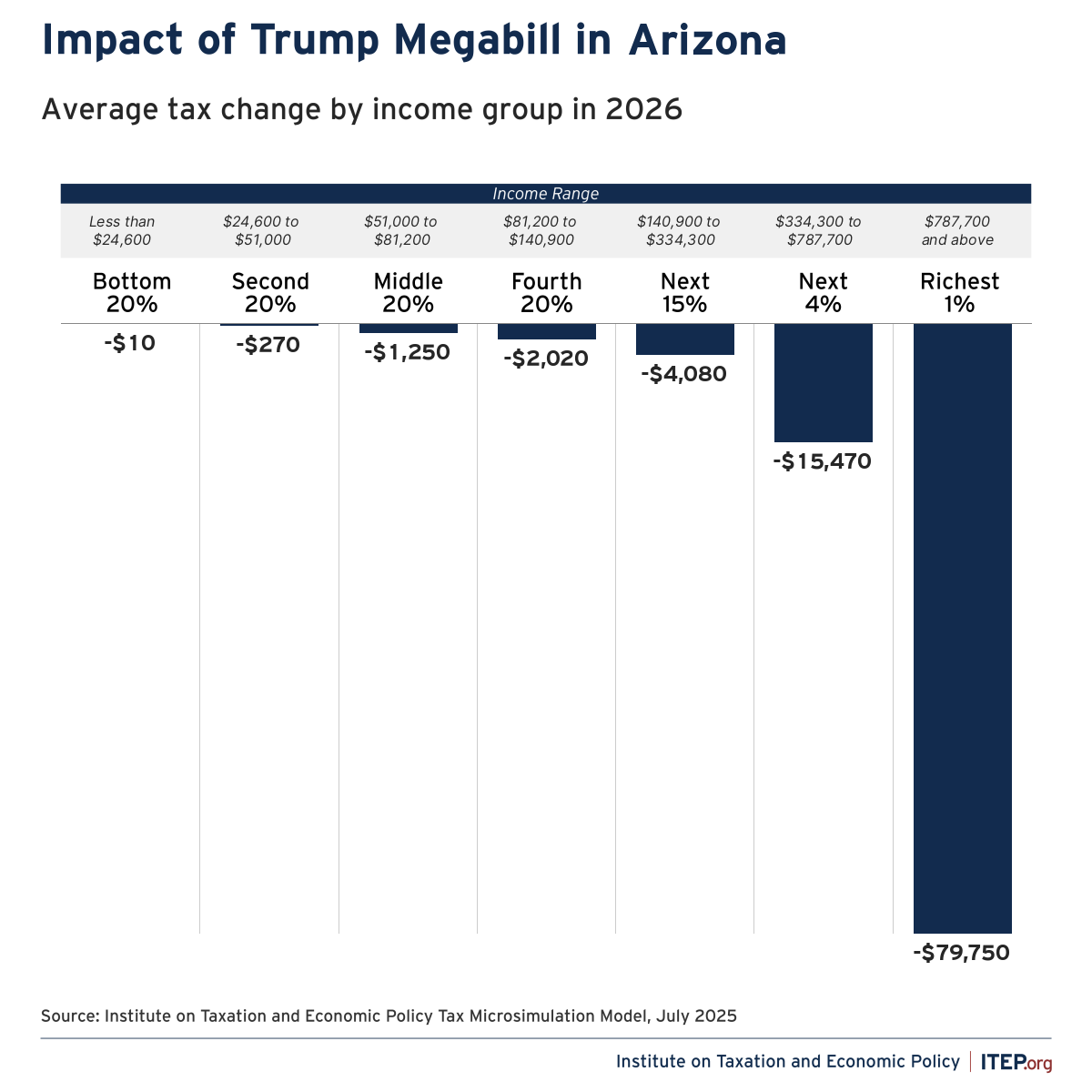
Punching down on low-income kids. Case in point: the vetoed budget would have stripped SUN Bucks (which provides summer meals to low-income children) of its $1.8 million line item, ending the program. When reporters asked Senate Majority Leader John Kavanagh (R-3) about the cut, he said that was a “false narrative” and that “it’s funded for this year.” This year’s SUN Bucks, however, run out on June 30 along with the rest of last year’s budget. The now-vetoed Republican budget did not approve the funding past July 1, which makes Kavanagh’s statement a blatant lie. It’s not just egregious (more than 400,000 Arizonans have lost their food stamp benefits, the most in the nation); it’s also ironic. If the state does not fund the program, Arizona will lose $80 million in federal matching dollars. That's penny-wise and pound-foolish, to say the very least.
A one-way ratchet. Tax cuts in Arizona are all but permanent. Restoring revenues takes a two-thirds supermajority in both chambers or 60%+ approval at the ballot, making it extremely unlikely that any of that money will ever come back.

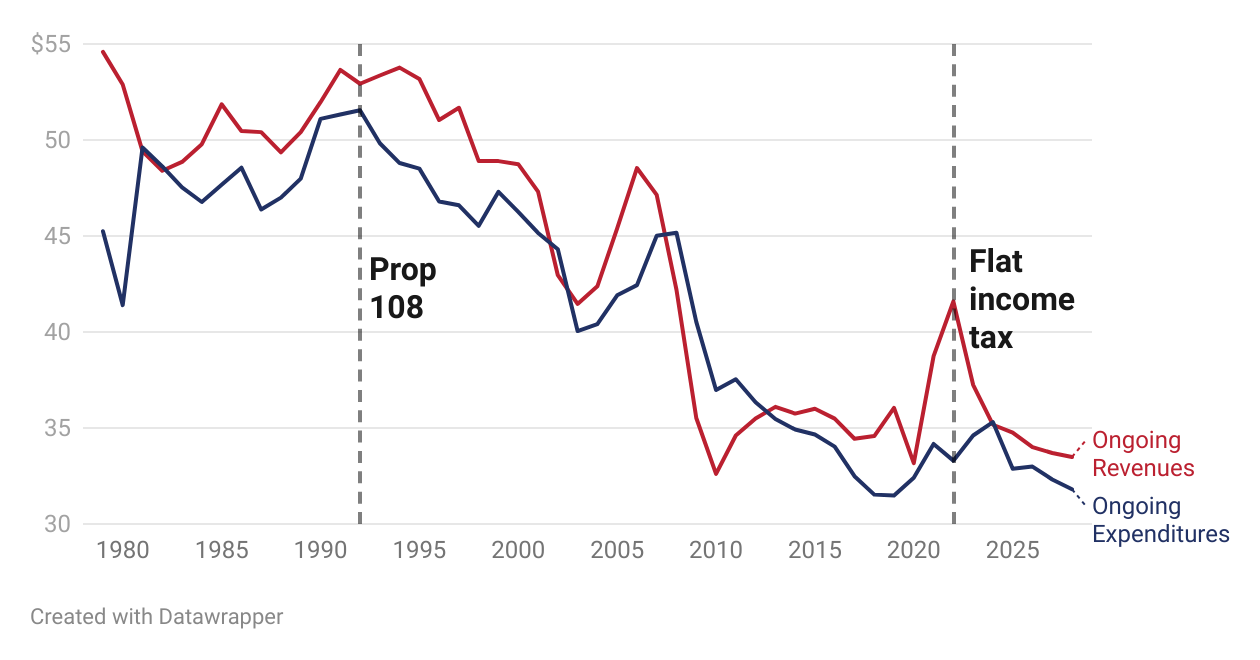
It doesn’t have to be this way. Republicans know Arizona can’t afford more tax giveaways, so they want to make broad cuts to the services we need and use to pay for them. (Want to dive deeper? The Arizona Center for Economic Progress has a good analysis of the pieces of HR1 and what each would cost.) Full conformity is by no means a done deal, but neither is avoiding it. Gov. Hobbs has twice vetoed the plan, but we’ve heard she may be willing to allow Republicans to get their way in exchange for a renewal of Prop 123 — something they should be doing anyway. We urge you to contact her office and make it clear you expect her to stand firm on NOT giving away what remains of Arizona’s precious state revenue.
Do you appreciate the many hours of work it takes to produce a resource like this every week? Become a paid subscriber and help keep us going:

We mentioned above that Republicans are sitting on bills they’ve passed (some nearly a month old) rather than send them to the governor. Here are the bills they’ve thus far refused to transmit and the date they got their last vote. Remember, these are not eligible for RTS; they have all passed and are non-actionable by rank-and-file lawmakers. The list is for informational purposes only.
Passed May 5
🐟 SB1037 (Finchem, R-1) is a copy of a vetoed bill from last year that would require voting equipment to meet "Department of Homeland Security standards." Many of its provisions, like prohibiting remote or Internet access, are already covered in state law; others are unneeded or actively harmful. The sponsor, who was at the US Capitol on January 6, has repeatedly claimed election fraud without evidence. OPPOSE.
If you see this little fish next to a bill, it indicates a failed or previously vetoed idea — something intended as "bait" to artificially drive up the governor's veto count and bolster stinky talking points.
"Any man who puts his intelligence up against a fish and loses had it coming." — John Steinbeck
SB1429 (Mesnard, R-13) would make it much harder for city and county initiatives and referenda to qualify for the ballot by pushing state-level restrictions, such as funding-related rules and circulator registration, down to the local level. (This language was added via a strike-everything amendment, but is similar to HB4115 and SB1489, which CEBV opposed earlier in session.) OPPOSE.
Passed April 16
HB2369 (Martinez, R-16) would require photo radar tickets to be signed by a judge, creating paperwork hurdles that would hamstring traffic enforcement. Currently, it's the ticketed person's responsibility to prove they are not the one in the photo. This attack on photo radar would mean more dangerous roads and more collisions. OPPOSE.
🌟 HB2673 (C Hernandez, D-21) would establish a study committee to institute basic safeguards for screening and treating mental illness in prisoners, a long-overdue move. In 2022, a federal judge ruled mental health care for incarcerated Arizonans is so bad it amounts to cruel and unusual punishment. SUPPORT.
Passed April 15
HB2456 (Wilmeth, R-2) would require counties with a population of 125,000+ to designate sufficient land for the construction and operation of data centers, data center facilities and small modular reactors — presumably on the premise of peppering our state with nuclear-powered data centers. OPPOSE.
Passed April 14
HB2592 (Wilmeth, R-2) would require every state agency to try to incorporate AI into its everyday operations. Agencies wouldn't be allowed to regulate its use without the legislature's express permission. Blindly trusting AI carries serious risk. We shouldn't be using it without some serious oversight, and we definitely shouldn't be using it to replace state employees. OPPOSE.
Passed April 13
HB2003 (Kupper, R-25) would drop the minimum age for getting a driver's permit to 15. This would increase both fatal crashes and accidents overall. OPPOSE.
🐟 HB2086 (Powell, R-14) would ban the state and district public (but not charter or voucher-funded) schools from requiring vaccines or masks. OPPOSE.
HB2140, (Fink, R-27) would allow the state of Arizona to invest in gold bullion based on tinfoil-hat beliefs that our banking system is imploding, the federal government has conspired to cause a crisis by controlling our money, and the end of Western civilization as we know it is imminent. The value of gold fluctuates wildly with the market, making this idea a volatile nightmare. OPPOSE.
HB2460 (Kupper, R-25) would ban cities from passing the cost of retrieving and returning businesses’ shopping carts on to those businesses. Multiple cities have cart recovery programs, which reduce blight and spur businesses to proactively manage the issue. Phoenix picked up nearly 8,000 carts in FY24 alone at considerable expense. OPPOSE.
HB2830 (Keshel, R-17) would require the State Board of Education to create fetal and prenatal human development lessons for public school science classes, while also banning schools from teaching students about how pregnancy happens. Schools that don’t comply would risk losing funding. This is a thinly veiled attack on voter-approved Prop 139. OPPOSE.
HB4056 (Martinez, R-16) would ban anyone from charging a state lawmaker reasonable fees for fulfilling a public records request. Lawmakers have an existing process to get public records, and district fees don’t even cover the staff time required to produce those records. It's petty, vindictive, and unnecessary for a lawmaker to stage this kind of publicity stunt instead of going through official channels. OPPOSE.
Passed April 9
SB1058 (Rogers R-7) would ban banks and credit cards from using merchant category codes that identify gun retailers or the purchase of guns or ammo. These codes are an important tool in flagging suspicious purchases. OPPOSE.
SB1237 (Kavanagh, R-3) would force Arizona's secretary of state to consult with county recorders and legislative leaders before creating Arizona's election procedures manual. Before the bill, Republicans lodged two years of failed lawsuits in which they tried and failed to impose their own views on the manual. OPPOSE.

2026 Session Timeline
Wednesday 6/24: Early ballots drop for the 7/21 primary election
Tuesday 6/30: Constitutionally mandated deadline to pass a state budget
Committees & Contacts
Here's a handy list of lawmaker contact info, committee chairs and assignments.
CEBV Action Linktree
Want other ways to take action? Need to stay informed? Looking for our social media, inspiration, or self-care tips? Look no further than our Linktree.
Congratulations, you made it to the end! Please click through to enjoy the Denali sled dog puppy cam, featuring the newest litter of pups at Alaska's Denali National Park. But don't say you weren't warned: the National Park Service advises, "Watching puppy webcam may cause sudden bouts of ‘aww’ and work productivity may drop to 0%." 🐕 Learn more about the puppy cam and Denali's sled dogs here.

Comments ()