
March 9, 2026
Ten pounds of you-know-what in a five-pound bag. A lopsided cutting-room floor. Regularly scheduled infighting. The bills are out there and they're coming.



You may notice that committee agendas still seem a bit light this week compared to what we've seen so far this year. The bills are still out there, trust us. Part of what's going on is the sheer volume of them (a record-breaking 2,120) and the time it's taking to force so many of them through a framework that was designed to support a part-time, low-volume legislature.
Lopsided hearings, long days. So far Republican leadership has chosen to advance most of the bills their members introduced, whether culture-war veto bait or an idea that can actually make it into law. Only 28% of the 1,439 (!) bills Republicans introduced failed to make it past the first bill deadline. This has led to incredibly long agendas and floor calendars; this past Wednesday, for example, House lawmakers were still working to pass bills to the other chamber with an eye-popping sixteen floor calendars. Meanwhile, as usual, Republican leadership chose to hear very few Democratic bills (76% of those 678 bills are now dead).
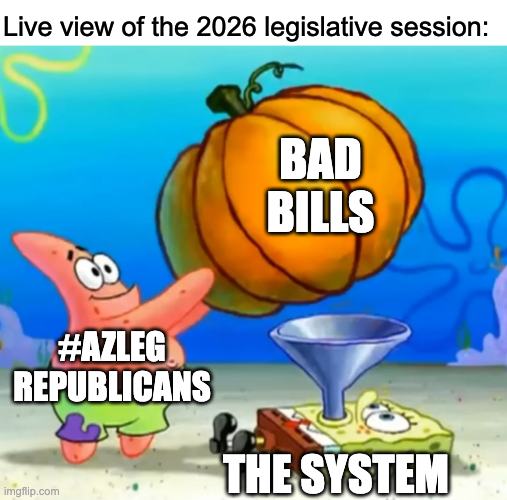
So much infighting, so little time. With the next bill deadline approaching, lawmakers have only two more weeks to cram hundreds of bills onto agendas. Complicating this process is the perennial Republican tug-of-war in both chambers over which direction to focus their energies. The caucus is not a monolith — far from it. The more pragmatic Republicans want to claim a few actual achievements the governor will sign, while the strident MAGA culture warriors want to energize hardline Republican voters. Within both legislative leadership and the rank-and-file, lawmakers hold vastly different and conflicting visions for which issues to prioritize, and they can't agree on which overall narrative they should stake their re-election campaigns. Like a car with two wheels on sideways, that's a recipe for trouble moving forward.
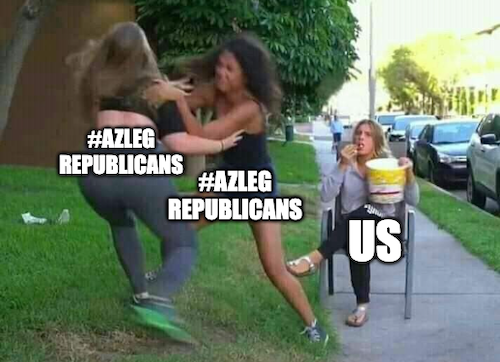
It's a feature, not a bug. The main casualty from all this infighting is actual progress that would help everyday Arizonans. For example, Republican leadership has given "grim reaper" Gail Griffin free rein for years to stalemate Arizona's water policy progress. She's notorious for hearing pretty much only her own (harmful) bills; year after year, she advances dozens of them to the governor's desk to be vetoed, while refusing to entertain even the most modest reforms. With state and county lawmakers and Arizonans across political parties frustrated and begging for action, you might wonder why Republican leadership keeps her in charge. It's a simple case of political favors: as one longtime lobbyist points out, she's "a loyal vote." In other words, they view this inaction as a feature, not a bug — to them, having Griffin as a reliable yes-man is worth any amount of stonewalling. And with the almost 82-year-old running once again in November in her deep red district, this time for the Senate, voters will have to change partisan control of the legislature to get Arizona's water future out from under her thumb.
 Kevin Volk Special to the Arizona Daily Star
Primaries incoming. Whether this temporary lull is due to infighting or bill volume or both, lawmakers must reckon with one incontrovertible fact: the newly moved-up primary election is creeping up on them. Voting begins June 24 (last year at that time, lawmakers were still in session!) and ends July 21, and many sitting lawmakers are vulnerable. Our legislature needs to bring this session to a close so they can campaign to retain power — and that’s a more powerful motivation for them than anything else.

⏰ If you have 5 minutes: Contact the members of the Senate Judiciary & Elections Committee to ask them to oppose HB2410. We recommend making phone calls; you'll get a polite assistant who will efficiently take your information. If you can't bring yourself to call, an email is fine, though not nearly as effective. See "Spotlight" below for more information.
⏰⏰ If you have 10 minutes: Also contact your own senator and representatives to ask them to pull the brakes on the ballot measures they are considering. See "Ballot Referrals" below for more information on the 4 measures being advanced through committees this week, or view our full list.
⏰⏰⏰ If you have 30 minutes: Also use Request to Speak to weigh in on the bills being heard in committees this week. Refer to the information, links and talking points in "Use RTS on These Bills" below to craft your own comments to lawmakers.
⏰⏰⏰⏰ If you have 40 minutes: Also contact our Hall of Shame lawmakers (see that section below) to tell them what you think.
⏰⏰⏰⏰⏰ If you have 50 minutes: Also reach out to Gov. Hobbs to thank her for vetoing SB1439. See "Veto Watch" below for more information.
⏰⏰⏰⏰⏰⏰ If you have 60 minutes: Join us on Zoom for our CEBV Happy Hour conversation, packed with political analysis, conversation and community. Our guest this week is Will Humble of the Arizona Public Health Association. Happy Hour meets every Sunday at 4 PM through the end of legislative session. We're looking forward to seeing you!

Last week we alerted you to HB2410, which would declare a person’s communication with AI "privileged," and warned that it had passed the House with a shocking 53 yes votes. This week the bill is being heard in a Senate committee, meaning it's time for us to double down on contacting our senators.
HB2410 (Kolodin, R-3) would give an AI chatbot the same legal status as advice from an actual human professional like a lawyer or therapist. This is deeply dangerous. This intentionally overbroad measure paves the way for the purposeful loss of high-paying jobs, using a model that was designed not to be confidential and that specifically warns users it cannot be made privileged. Last month, a federal judge in New York ruled that use of a public AI tool is not privileged communication; analysis shows AI fails all prongs of the relevant doctrinal test. See last week's "Spotlight" for much more on this terrible bill.
HB2410 is scheduled for Senate Judiciary & Elections Committee, Wednesday. Contact the members of the committee as follows to OPPOSE:
Wendy Rogers (R-7), Chair • wrogers@azleg.gov • 602-926-3042
John Kavanagh (R-3), Vice Chair • jkavanagh@azleg.gov • 602-926-5170
Shawnna Bolick (R-2) • sbolick@azleg.gov • 602-926-3314
Mark Finchem (R-1) • mfinchem@azleg.gov • 602-926-3631
Teresa Hatathlie (D-6) • thatathlie@azleg.gov • 602-926-5160
Lauren Kuby (D-8) • lkuby@azleg.gov • 602-926-4124
Analise Ortiz (D-24) • analise.ortiz@azleg.gov • 602-926-3633
Do you appreciate the many hours of work it takes to produce a resource like this every week? Become a paid subscriber and help keep us going:

One of our tasks is to hold our allies accountable. This section calls out those who support harmful bills. We ask them to heed and do better.
This week, we're disappointed in:
👎 Janeen Connolly (D-8) for voting YES on HB2903 on the House floor. This bill would ban the state from requiring banks to consider social or environmental values when lending. This is something that Arizona is not requiring. The idea appears driven by a panic that society will hold extremists accountable for their actions. See our explainer on ESG. Other than Connolly's vote, this bill passed with only Republican support. It now advances to the Senate for committee assignment. Contact her at jconnolly@azleg.gov or 602-926-3300.
👎 Alma Hernandez (D-20), 👎 Consuelo Hernandez (D-21), 👎 Lydia Hernandez (D-24), 👎 Elda Luna-Najera (D-22), and 👎 Myron Tsosie (D-6) for voting YES on HCR2004 on the House floor. This measure would force cities to run elections every 10 years to ask voters if they can use photo‑radar cameras, regularly clogging our ballots. Nobody likes a ticket, but Arizona has had photo radar since 1987 for good reason. Numerous studies have found speed and red-light cameras reduce traffic crashes and injuries by up to 35 percent. Repealing photo radar would lead to more dangerous roads and more collisions. Duplicate bill SCR1004 now needs a floor amendment to conform the two measures, after which this measure can advance to our ballots without any further public input. Contact these lawmakers as follows:
▶️ Alma Hernandez • ahernandez@azleg.gov • 602-926-3136
▶️ Consuelo Hernandez • chernandez@azleg.gov • 602-926-3523
▶️ Lydia Hernandez • lhernandez@azleg.gov • 602-926-3553
▶️ Elda Luna-Najera • eluna-najera@azleg.gov • 602-926-3881
▶️ Myron Tsosie • mtsosie@azleg.gov • 602-926-3157
👎 Brian Fernandez (D-23) and 👎 Rosanna Gabaldon (D-21) for voting YES on SB1519 on the Senate floor. This bill would increase the weight limit for off-highway vehicles from 2500 to 3500 pounds at the request of an off-road vehicle company, Polaris Industries — effectively selling our desert to Polaris to be torn up in exchange for a small amount of vehicle license tax revenue. Excessive off-roading is already destroying pristine habitat in Arizona; heavier vehicles will do even more harm. The bill now advances to the House for committee assignment. Contact Fernandez at bfernandez@azleg.gov or 602-926-3098; contact Gabaldon at rgabaldon@azleg.gov or 602-926-3424.

Lawmakers are advancing these measures through committees this week with the ultimate goal of placing them on our November ballot. We are tracking a stunning thirty-eight potential measures. (See the full list here.) For comparison, our 2024 ballots contained eleven legislative referrals, which was at that time the most in 20 years and forced election officials in Maricopa and Pima Counties to print our ballots across two sheets of paper.
All the below bills have already made it through one full chamber. Unlike regular bills, these referrals cannot be vetoed. Use RTS to weigh in; refer to the information, links and talking points here to craft your own comments to lawmakers.
 Wayne Schutsky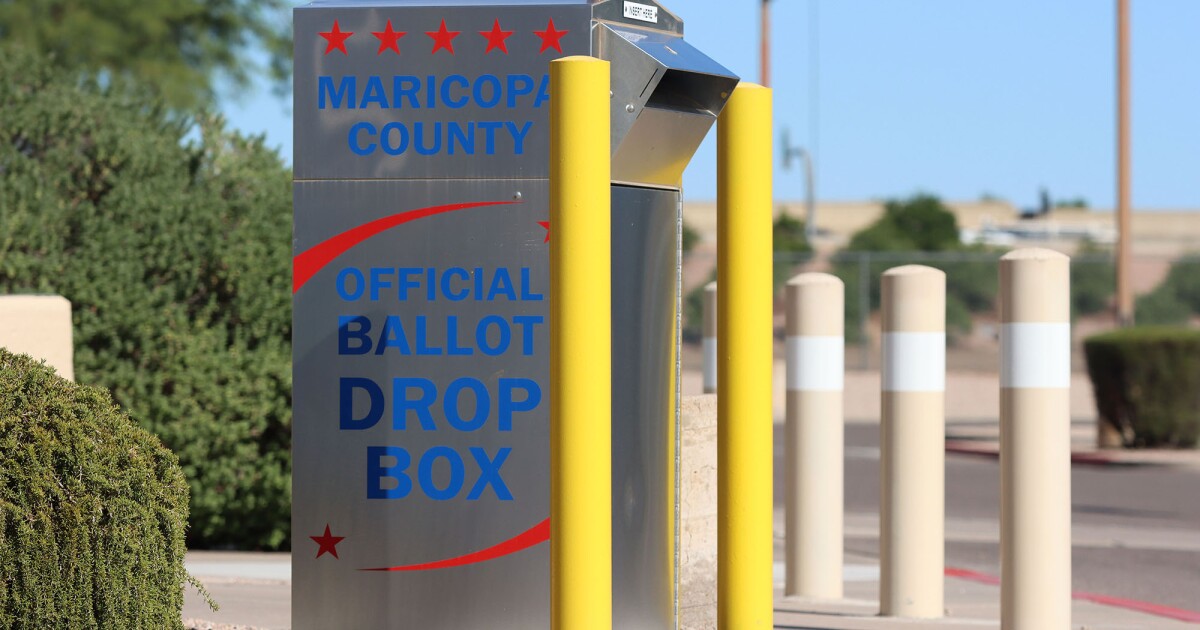
SCR1024, sponsored by JD Mesnard (R-13), would ask voters to require state lawmaker candidates to live in the legislative district they want to represent, instead of in the county, for at least one year before the election. Given that several actual lawmakers don’t reside in the districts they represent, and that violating current law carries basically no consequences (and this measure wouldn't change that), SCR1024 is a waste of time and ballot space. Scheduled for House Government Committee, Wednesday. OPPOSE.
SCR1028, sponsored by JD Mesnard (R-13), would ask voters to amend the Arizona Constitution to require a two-thirds supermajority vote of the Legislature for statewide fees and assessments. A similar Constitutional provision for taxes has strangled state government over decades, making it nearly impossible to fund our state’s many needs and priorities. Scheduled for House Ways & Means Committee, Wednesday. OPPOSE.
HCR2003, sponsored by Selina Bliss (R-1), would ostracize the tiny minority of trans girls in Arizona by asking voters to ban them from youth sports, as well as banning trans youth from using the school bathrooms and changing facilities that align with their gender identities. Anti-trans hate creates a toxic environment for girls in sports, inviting harassment of girls who are “too good at the game” or have stocky builds, small breasts or short hair, and subjecting them to humiliation, verbal assault, physical attacks or even invasive genital exams meant to “prove” they are girls. The demand that female athletes conform to rigid gender norms or face the consequences is dangerous to all women, not just athletes. This measure is a close copy of a 2022 law courts have already blocked, which a federal district judge put on hold pending the outcome of a similar US Supreme Court case. Scheduled for Senate Education Committee, Wednesday. OPPOSE.
HCR2016, sponsored by Rachel Keshel (R-17), is a copy of a failed bill from last year that would ban voting centers in Arizona and return the state to precinct-based voting with just 1,000 registered voters at each precinct. Every voter would be assigned a neighborhood polling location; the ballots of voters who go to the wrong polling place would be thrown out. Before Arizona shifted to our current voting center model, our elections were plagued by long lines and technology issues, and tens of thousands of votes were never counted for being cast at the wrong location. This ridiculous, deeply flawed proposal would return Arizona's elections to those days. Scheduled for Senate Judiciary & Elections Committee, Wednesday. OPPOSE.

On the Governor's Desk
This past week, Gov. Hobbs exercised her power to protect Arizonans from the following harmful, CEBV-opposed legislation. Contact her office to say thank you at 602-542-4331 or engage@az.gov.
Vetoed: Friday, March 6
- SB1439 (Hoffman, R-15), which would have created a special license plate for Charlie Kirk. Veto letter here.

A strict calendar dictates that bills must be heard in committee in their originating chamber by the end of this week. RTS will end entirely on April 2, when regularly scheduled committees stop meeting.
Affordability
SB1115, sponsored by Carine Werner (R-4), would ban employees of Arizona's Medicaid system, AHCCCS, from working remotely. This ban would cost the state additional money and could be difficult to implement. Four in 10 state employees now work remotely either full-time or hybrid, saving the state $32 million in rent and an additional $58.6 million in deferred maintenance since 2021. Scheduled for House Health & Human Services Committee, Monday. OPPOSE.
SB1142, sponsored by Shawnna Bolick (R-2), would make Arizona one of the first states in the nation to irresponsibly sign up for Trump’s federal voucher scam. This is designed as a tax giveaway for the rich; like Arizona’s vouchers, it's designed to benefit wealthier students already in private schools. The federal voucher program has no cap, meaning it could funnel billions of dollars a year to private schools already receiving state tax dollars via state vouchers, with zero accountability to taxpayers. Scheduled for House Ways & Means Committee, Wednesday. OPPOSE.
SB1501, sponsored by David Gowan (R-19), would attack the ability of our state government to function efficiently by directing the Administrative Rules Oversight Committee to hunt down agency rules that "exceed their statutory authority" (i.e., go any further than lawmakers want them to) and recommend legislative changes. Rule making is a specialized, data-driven process best carried out by skilled officials. Allowing the legislature to inject argumentative chaos into nonpartisan regulatory decisions would clog the process, creating confusion or even stalemate. Scheduled for House Government Committee, Wednesday. OPPOSE.
Discrimination
HB2085, sponsored by Lisa Fink (R-27), would ban medical personnel from prescribing puberty-blocking hormones to anyone under the age of 18 to treat gender dysphoria. Age-appropriate hormones can provide time for kids and their families to explore gender identity, access psychosocial supports, develop coping skills, and further define appropriate treatment goals. This bill would wedge politicians between trained medical professionals and their patients by targeting health care providers and community support systems. Scheduled for Senate Judiciary & Elections Committee, Wednesday. OPPOSE.
HB2184, sponsored by Julie Willoughby (R-13), would change eligibility for fetal death certificates by allowing them to be issued for embryos and fetuses before 20 weeks of gestation. (This is way before fetal viability, the point at which a fetus can survive outside a uterus.) The bill removes the term "fetus" from statute, replacing it with "unborn child," and would also require doctors to tell anyone having an abortion that they can transfer the "bodily remains" to a funeral home. This is part of the anti-scientific strategy of “fetal personhood,” which gives fetuses the same legal rights as people (to the detriment of women). It also likely violates voter-approved Prop 139. The bill has a proposed striker; we don't have full language yet, but the short title indicates it will likely be just more of the same. Scheduled for Senate Regulatory Affairs & Government Reform Committee, Wednesday. OPPOSE.
HB2249, sponsored by Lisa Fink (R-27), would require teachers to get written parental consent before using a student’s chosen name or pronouns if they differ from the student's given name or biological sex. The bill also requires schools to give parents access to all of their minor children’s records, stripping minors of their right to privacy and educators of the right to exercise their professional judgment on when to divulge information. Schools would be forced to make "coercing a minor to withhold information from a parent" grounds for employee discipline, with minimum statutory damages of $500,000 against a school district and $20,000 against an administrator, which could not come from public funds. Scheduled for Senate Education Committee, Wednesday. OPPOSE.
Energy, Water & Climate
🐟 SB1281, sponsored by David Farnsworth (R-10), would require both chambers of the legislature to vote to approve any sale of land to the federal government. The idea seems to be to stop land from being turned into national monuments. That would threaten not only conservation efforts, but Arizona’s $1.4 billion outdoor recreation industry and the local economies tied to it. Gov. Hobbs vetoed a very similar bill in 2024. Scheduled for House Federalism, Military Affairs & Elections Committee, Wednesday. OPPOSE.
If you see this little fish next to a bill, it indicates a previously vetoed idea — something intended as "bait" to artificially drive up the governor's veto count and bolster stinky talking points.
"Any man who puts his intelligence up against a fish and loses had it coming." — John Steinbeck
🐟 SB1418, sponsored by Frank Carroll (R-28), is a bill vetoed last year that would ban counties from using zoning regulations for small modular reactors colocated with "a large industrial energy user," such as a data center or aluminum smelter. The purpose seems to be to pepper our state with nuclear-powered data centers. This flies in the face of voter wishes; Arizonans of all political affiliations are pushing back against data centers in our communities due to their excessive land, energy and water usage. Part of a package of bills that would create broad exemptions for this untested, hazardous technology and force it into our state. See duplicate bill HB2456 (Wilmeth, R-2). Scheduled for House Natural Resources, Energy & Water Committee, Tuesday. OPPOSE.
HB2026, sponsored by Gail Griffin (R-19), would create a new loophole for developers to get around assured water supply requirements. Arizona has less water now than it did 20 years ago; it's time developers accepted that fact instead of trying to destroy consumer protections so they can pump more water than they're entitled to. Scheduled for Senate Natural Resources Committee, Tuesday. OPPOSE.
HB2056, sponsored by Gail Griffin (R-19), would require the state to spend time and money studying whether it can desalinate brackish groundwater. Water experts call the use of brackish groundwater "a mirage," pointing out the laundry list of environmental, physical, financial, technical, regulatory and legal barriers to its use. This bill is a waste of taxpayer dollars and a distraction from real solutions. Scheduled for Senate Natural Resources Committee, Tuesday. OPPOSE.
HB2094, sponsored by Gail Griffin (R-19), is a failed bill from last year exempting specific proposed housing developments in Queen Creek and Buckeye from a building moratorium by citing 20-year-old groundwater supply models. This would benefit developers and could result in excessive groundwater pumping. The water that would be used to replenish any water pumped (which is required) would come almost exclusively from the Colorado River, which is likely to face steep cuts in the near future. See duplicate bill SB1200 (Shope, R-16). Scheduled for Senate Natural Resources Committee, Tuesday. OPPOSE.
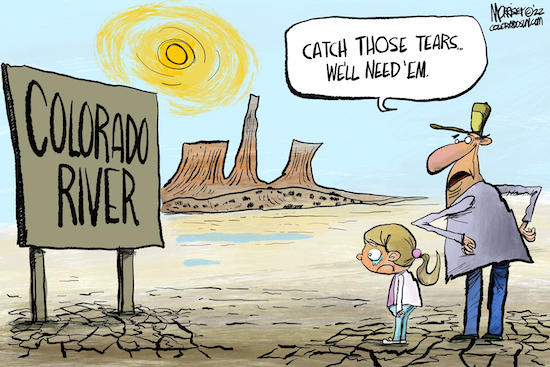
HB2101, sponsored by Gail Griffin (R-19), would mess with the state's ability to assess groundwater supply and demand by relying on modeling instead of actual data. Scheduled for Senate Natural Resources Committee, Tuesday. OPPOSE.
Public Safety
SB1010, sponsored by Warren Petersen (R-14), would rename Loop 202 to the “Charlie Kirk Highway.” Parts of Loop 202 already have a name, including a 23-mile stretch named for longtime Arizona congressman Ed Pastor, who was instrumental in securing the federal funds for its construction. The bill politicizes the highway naming process, generally handled by the legislatively created Arizona State Board on Geographic and Historic Names; the board's policy to not name something after people until at least five years after their death avoids political controversy and allows historical perspective. Then there's the practicality of the suggestion: the horrific way Kirk was killed does not excuse the combative, incendiary, racist and sexist behavior around which he constructed his public work. Scheduled for House Transportation & Infrastructure Committee, Wednesday. OPPOSE.
SB1061, sponsored by Wendy Rogers (R-7), would lower the threshold for mandatory sentencing of people who sell fentanyl to just 9 grams, down from 200. These people would be required to serve 5 to 15 years in prison, 10 to 20 years for repeat offenders. This threshold could result in arrests or prosecutions of people with legitimate uses for the drug, such as cancer patients and others who use it for treating pain. Tougher mandatory sentences won't do anything to curb the fentanyl crisis (which is trending downward as it is), and Arizona already has the seventh-highest incarceration rate in the nation. Scheduled for House Judiciary Committee, Wednesday. OPPOSE.
🐟 SB1068, sponsored by Wendy Rogers (R-7), is an exact copy of a vetoed bill from last year that would prohibit universities and community colleges from banning anyone with a concealed weapons permit — not just students — from possessing, storing or transporting guns on campus. College campuses and guns are a deadly combination, increasing the risks of suicide, homicide and sexual assault. Even our founding fathers believed guns had no place on college campuses. Scheduled for House Judiciary Committee, Wednesday. OPPOSE.
🐟 SB1069, sponsored by Wendy Rogers (R-7), is an exact copy of a vetoed bill from last year that would legalize silencers. This dangerous bill would make it harder for bystanders and law enforcement to identify and react quickly to gunshots. Scheduled for House Judiciary Committee, Wednesday. OPPOSE.

SB1148, sponsored by Mark Finchem (R-1), would take the responsibility of attorney licensing away from the State Bar and give it to the Arizona Supreme Court. It would also ban requiring an attorney to belong to the State Bar to be licensed in Arizona. The sponsor carries a grudge against the Bar: they sanctioned his lawyer for a frivolous, bad-faith suit challenging his 2022 loss in the secretary of state race and forced him to repay almost $50,000 in legal fees. Scheduled for House Judiciary Committee, Wednesday. OPPOSE.
SB1424, sponsored by Wendy Rogers (R-7), would require public district and charter schools (but not private or ESA voucher-funded schools) to teach “age-appropriate firearm safety awareness” in every year and every grade, kindergarten through 12th. Scheduled for House Education Committee, Tuesday. OPPOSE.
HB2003, sponsored by Nick Kupper (R-25), would drop the minimum age for getting a driver's permit to 15. Data from the Insurance Institute for Highway Safety shows this would increase both fatal crashes and accidents overall; the institute recommends a minimum permit age of 16 as a best practice. Teen drivers have crashes at nearly 4 times the rates of drivers ages 20+. Scheduled for Senate Appropriations, Transportation & Technology Committee, Tuesday. OPPOSE.
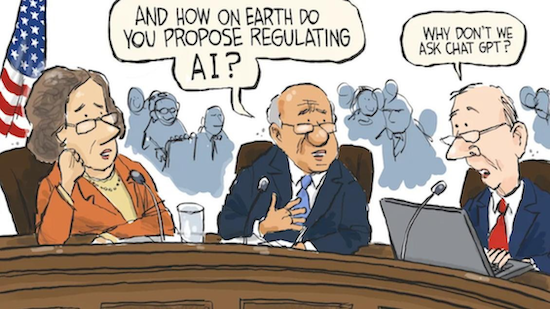
HB2410, sponsored by Alexander Kolodin (R-3), would declare a person’s communication with AI "privileged" just as it would be if the person sought advice from an actual human professional such as a lawyer. A federal judge in New York recently ruled that use of a public AI tool is not privileged communication, as it fails all three prongs of the required test, leading multiple law firms to issue warnings that "AI is not your lawyer." AI portals' own legal disclaimers warn users they are not legal advice or counsel and specify that people use AI at their own risk. Passed the House with a shocking 53 yes votes. Scheduled for Senate Judiciary & Elections Committee, Wednesday. OPPOSE.
Voting Rights, Elections & Direct Democracy
🐟 SB1037, sponsored by Mark Finchem (R-1), is a copy of a vetoed bill from last year that would require voting equipment to meet "Department of Homeland Security standards." Many of the security measures in the bill, like prohibiting remote access and Internet access, are already covered by Arizona law. Multiple elections officials have testified over multiple years that other provisions of the bill are either unneeded or actively harmful. The sponsor, who was at the US Capitol on January 6, has repeatedly claimed without evidence that election machines were remotely hacked in 2020 and 2022. Scheduled for House Federalism, Military Affairs & Elections Committee, Wednesday (held last week). OPPOSE.
🐟 SB1040, sponsored by Mark Finchem (R-1), is a copy of a bill vetoed last year that would force county recorders to let anyone download voter registration rolls for free. Creating public, no-cost access to voter rolls enables spam and harassment, and allows bad actors to easily generate fake purge lists. This threatens the integrity of our elections. Scheduled for House Federalism, Military Affairs & Elections Committee, Wednesday (held last week). OPPOSE.
HB2167, sponsored by Lupe Diaz (R-19), would stop Arizona's attorney general from filing a “public nuisance action” or penalize her for doing so. Benson residents are suing to stop an aluminum smelting plant from being built in the middle of their community and have asked AG Mayes to intervene; she says nuisance law (which she famously used against Saudi company Fondomonte) is the strongest tool she has to help them. Diaz supports the smelting plant. Scheduled for Senate Judiciary & Elections Committee, Wednesday. OPPOSE.

2026 Session Timeline
Friday 3/27: Last day for a bill to get out of committees in its crossover house
Friday 4/3: End of crossover Appropriations committees, and the last day to use RTS until a budget drops
Tuesday 4/21: 100th Day of Session (the purported end goal; can be changed)
Tuesday 6/30: Constitutionally mandated deadline to pass a state budget
Committees & Contacts
Here's a handy list of lawmaker contact info, committee chairs and assignments.
CEBV Action Linktree
Want other ways to take action? Need to stay informed? Looking for our social media, inspiration, or self-care tips? Look no further than our Linktree.
Congratulations, you made it to the end! 🎉 Please take a moment to enjoy some Very Good Dogs.
This delivery driver throws treats to all the dogs on his route to see if they can catch. Spoiler alert: some of them definitely cannot. Still 13/10 for all (TT: jezzyvi)
— WeRateDogs (@weratedogs.com) 2026-03-05T20:20:07.076Z
Comments ()