
March 2, 2026
The first bill deadline. Way too early for an all-nighter. That bot isn't your lawyer. Fishing for vetoes.
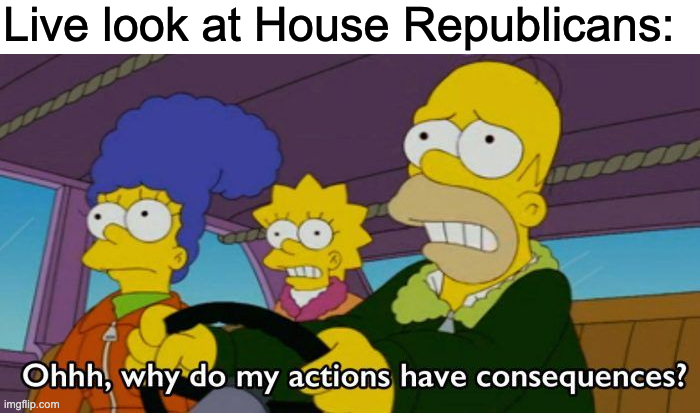


We thought we knew what Crossover Week held in store for us. We expected for lawmakers to spend long days voting on massive floor calendars, and for more than half of this year's 2,118 bills to quietly die without ever receiving a committee hearing. Both those things did happen — but, as it turns out, the legislature can also still surprise us.
We've been talking for weeks about this year's unprecedented volume of time-waster bills, a scenario that some¹ have compared to monkeys flinging feces at the zoo. This week, those chickens finally came home to roost. On Wednesday, House Republicans scheduled an all-nighter for their chamber, something that normally only happens at budget time.² The nearly 200 bills on that all-night calendar included previously vetoed ideas, duplicative measures addressing the same issues, and measures on "reconsideration" that had already failed at least once. Every single bill was sponsored by a Republican.
It is almost 4:30 a.m. and the Arizona House is still doing third readings of bills. They started at 6:34 p.m..
— Jerod MacDonald-Evoy (@jerodmacevoy.com) 2026-02-26T11:28:06.385Z
Republican leadership didn't have to do this. They could have split the workload they'd created into two regular-sized days, especially when it became clear they had set themselves up to work past 5 AM. Instead, they leaned in, ordering in a literal espresso bar to try to keep exhausted lawmakers and staff going. One Republican vocally expressed his displeasure throughout the process and ended up leaving before voting was over; they trimmed their calendar, but kept at it. Leaders also tried to blame their spectacular self-own on the minority party, though Democrats cannot set calendars or timelines and have very little overall power.
 , The Arizona Republic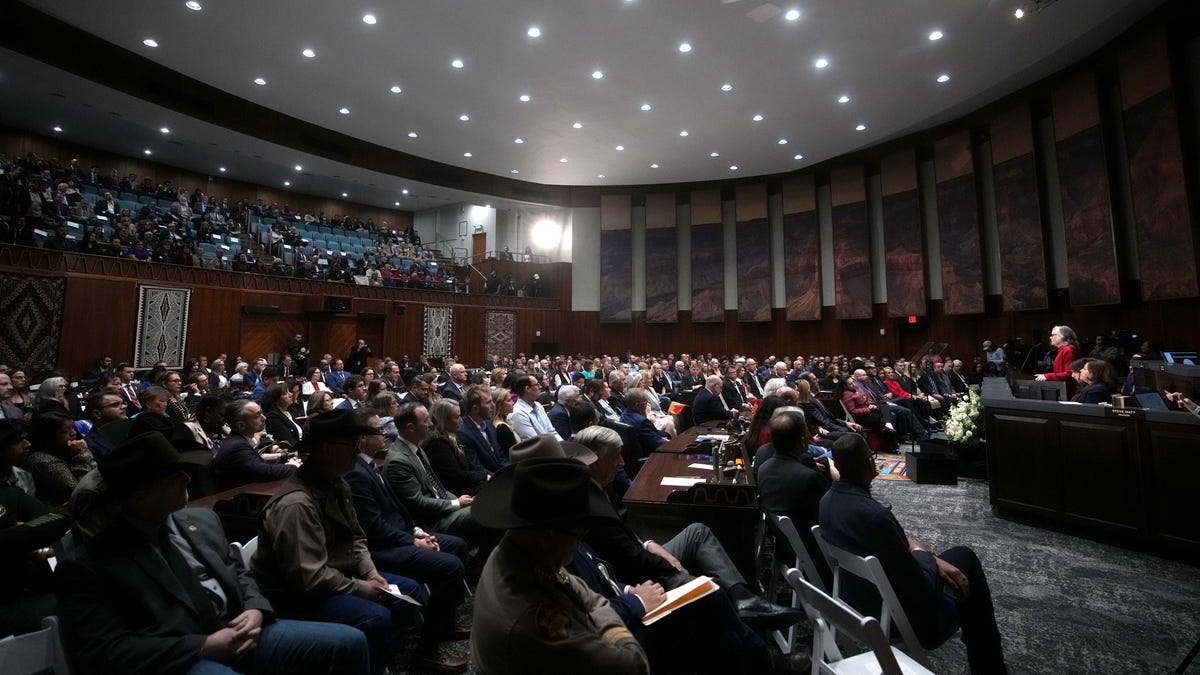
It was an extraordinary example of the train wreck that our state government has become over the past 10 years as MAGA increased its pull at the Capitol, yawing sharply into irrational extremism as they drum out any Republican with even the barest modicum of common sense. As the saying goes, if voters elect clowns, they can expect a circus.
This week, committee hearings are getting a slow start, with light agendas and several committees not planning to meet. It seems both chambers might have a Crossover Week hangover. On Monday, both chambers are gaveling in for floor calendars to vote through even more garbage. In the meantime, we are still tracking 337 vetoable bills and 38 ballot referrals — which is SO MANY MORE than in previous years.
When committees do get going again, they'll have a more focused perspective. Every bill you'll read about here³ will have made it through one chamber, placing them one step closer to the governor's desk (or our ballots).

⏰ If you have 5 minutes: Directly contact your own senator to ask them to oppose the Spotlight bill when it comes before them. We recommend making phone calls; you'll get a polite assistant who will efficiently take your information. If you can't bring yourself to call, an email is fine, though not nearly as effective.
⏰⏰ If you have 10 minutes: Also contact your own representatives to express your feelings about their vote on the Spotlight bill.
⏰⏰⏰ If you have 20 minutes: Also contact your own senator and representatives to ask them to pull the brakes on the ballot measures they are considering. See "Ballot Referrals" below for more information on what's moving this week, or view our full list.
⏰⏰⏰⏰ If you have 40 minutes: Also use Request to Speak to weigh in on the 17 bills being heard in committees this week. Refer to the information, links and talking points in "Use RTS on These Bills" below to craft your own comments to lawmakers.
⏰⏰⏰⏰⏰ If you have 50 minutes: Also contact our Hall of Shame lawmakers (see that section below) to tell them what you think.
⏰⏰⏰⏰⏰⏰ If you have 60 minutes: Join us on Zoom for our CEBV Happy Hour conversation, packed with political analysis, conversation and community. Happy Hour meets every Sunday at 4 PM through the end of legislative session. We're looking forward to seeing you!

WTF moment of the week: We were shocked when, last Monday, 21 of the House's 27 Democrats voted for HB2410 (Kolodin, R-3) alongside every Republican. This bill declares a person’s communication with AI "privileged" just as it would be if the person sought advice from an actual human professional such as a lawyer or therapist. Here's what's wrong with that:
1️⃣ Dangerous. These bots can sound very convincing, even legitimate. Some explicitly market themselves as being “for mental health” or as "your AI lawyer." But these tools can “hallucinate” (make things up), especially when asked complex questions, and they're designed to keep people using them for as long as possible, which can reinforce harmful behavior. Lawyers have used AI to create error-riddled court documents that could lead to wrongful convictions. Multiple studies find bots exhibit biases in race, gender, social class and income, and mental health. Chatbots systematically violate ethics standards. Children have committed suicide after conversations with bots. Making AI privileged elevates it to the same standard as human care — a viable replacement for a lawyer or psychologist — and that's deeply dangerous.
2️⃣ Designed to be overbroad. The sponsor said he purposely wrote HB2410 very broadly. By doing that, he's created numerous loopholes. As currently written, the bill allows leaky platforms to promise us secrecy without building any safeguards. It's not inconceivable that bad actors could launder compromising information simply by running it through an AI interface — for instance, by having a bot "take notes" in a meeting. And as for letting the courts decide, public confidence in the judiciary has recently dropped to an all-time low.
3️⃣ A job killer. Despite supporters' claims that HB2410 won't replace educated, trained professionals, the sponsor made it clear in committee that he feels AI could and should be replacing lawyers, and that he himself uses AI for that purpose. This paves the way for the purposeful loss of high-paying jobs (and the continued "enshittification" of society), allowing people to be replaced with chatbots without any legal consequences.
4️⃣ Never built to be confidential. Networked online models and chatbots aren't just violating our confidentiality already, they're purpose-built to do it. Their data use and retention policies specify that these models are designed to allow sharing with third-party services. This is a systemic issue. AI servers can't reliably keep data confidential, and companies like Meta implicitly acknowledge that the use of its AI will leak people's private information.
5️⃣ Never meant to be privileged. A federal judge in New York recently ruled that use of a public AI tool is not privileged communication. Analysis of the ruling shows AI fails all four prongs of the relevant doctrinal test. Multiple law firms have since issued warnings that "AI is not your lawyer." Legal publications such as the Harvard Journal of Law & Technology are also taking a strong stance against making AI privileged. Regardless of legal opinion on this, a lack of privilege is baked into the product: AI portals' own disclaimers warn users they are not offering legal advice or medical treatment, and specify that we're using AI at our own risk.
HB2410 now proceeds to the Senate for committee assignment. The only four lawmakers to vote no were Aaron Marquez (D-5), Mae Peshlakai (D-6), Mariana Sandoval (D-23), and Stacy Travers (D-12). Contact your House representatives and tell them what you think, but more importantly, contact your senator and ask them to OPPOSE this dangerous bill.
Do you appreciate the many hours of work it takes to produce a resource like this every week? Become a paid subscriber and help keep us going:

One of our tasks is to hold our allies accountable. This section calls out those who support harmful bills. We ask them to heed and do better.
This week, we're disappointed in:
👎 Brian Fernandez (D-23) for voting YES on SB1053, SB1058 and SB1069 on the Senate floor.
- SB1053 would create a new concealed weapons permit fee for Arizona residents and set them at just 10% of the fee for non-residents. This would not only irresponsibly reduce funding for the Department of Public Safety, but would likely increase the number of concealed weapons in Arizona, impacting public safety.
- SB1058 would ban banks from using merchant category codes that identify gun retailers or the purchase of guns or ammo. Not only are these codes important for flagging suspicious purchases, which can help curb gun violence, but peer-to-peer banking services (Venmo, Google Pay, Paypal, etc.) don't allow firearms or ammo purchases. Without identifying purchase categories, businesses cannot comply with terms that are being set by the free market.
- SB1069 would legalize silencers, even when used or sold with intent to harm or kill someone. Making it harder for bystanders and law enforcement to identify and react quickly to gunshots would put us all at risk.
Other than Fernandez's vote, all three of these bills passed with only Republican support. Each now advances to the House for committee assignment. Contact Fernandez at bfernandez@azleg.gov or 602-926-3098.
👎 Lydia Hernandez (D-24) for voting YES on HB2101 and HB2745 on the House floor.
- HB2101 would mess with the state's ability to assess groundwater supply and demand by relying on modeling instead of actual data.
- HB2745 would allow the legislature to arrest anyone who refuses to comply with a subpoena they issued — including another elected official — and physically haul them before a committee. This would likely be weaponized; in 2024, some far-right legislators convened a hearing to call for the impeachment of Attorney General Kris Mayes (but did not succeed).
Other than Hernandez's vote, each of these bills passed with only Republican support. She did not explain her votes. The bills now advance to the Senate for committee assignment. Contact her at lhernandez@azleg.gov or 602-926-3553.

Lawmakers are advancing these measures through committees this week with the ultimate goal of placing them on our November ballot. We are tracking a stunning thirty-eight potential measures. (See the full list here.) For comparison, our 2024 ballots contained eleven legislative referrals, which was at that time the most in 20 years and forced election officials in Maricopa and Pima Counties to print our ballots on two sheets of paper.
Unlike regular bills, these referrals cannot be vetoed. Use RTS to weigh in; refer to the information, links and talking points we include here to craft your own comments to lawmakers.
 Wayne Schutsky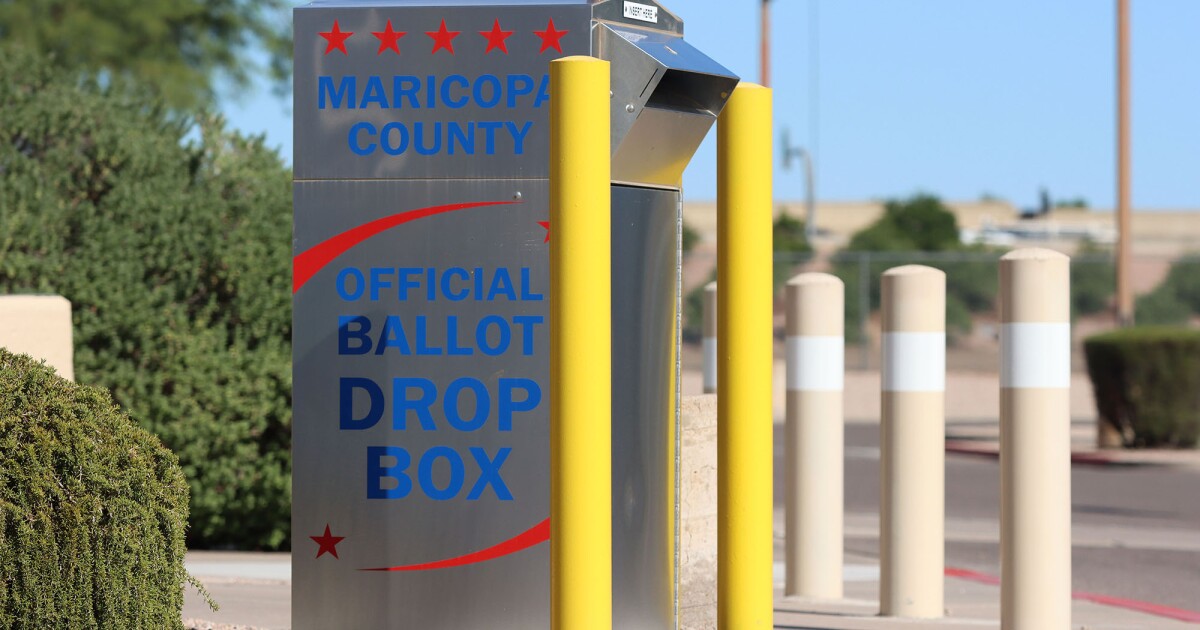
SCR1006, sponsored by John Kavanagh (R-3), is an anti-LGBTQ+, anti-student "bathroom ban" and "pronoun ban" that would go directly to our ballot. The bill would ban teachers from using a student’s chosen pronouns without written parental permission, and would ban trans kids from using the school bathrooms, changing facilities and “sleeping quarters” that fit their gender identities. Trans kids wouldn’t be able to use any school facilities at all without undue scrutiny of their bodies, which the bill calls a "reasonable accommodation." Anyone who “encounters” a trans person in a bathroom could file suit against a public school. These Republican-led bills are worsening LGBTQ+ Arizonans’ struggle to simply exist by creating discrimination, legal red tape, and mental and emotional distress. The governor has vetoed these concepts twice before, but this measure would evade her veto. Scheduled for House Education Committee, Tuesday. OPPOSE.


On the Governor's Desk
Even if we expect these bills to receive a veto, it remains important to contact the governor’s office to request one. This creates a body of evidence demonstrating that her actions have strong public support. Learn how to write a veto request letter by reading our guide here.
SB1439 (Hoffman, R-15) would create a special license plate for Charlie Kirk. Arizona already has a whopping 109 special plates. The horrific way Kirk was killed does not excuse the combative, incendiary, racist and sexist behavior around which he constructed his public work. Each plate sold generates $17 to financially benefit a group; this one is designed to fund Turning Point USA. The sponsor worked closely with Kirk, and his companies have been paid millions of dollars by TPUSA, raising questions as to whether he would directly profit from this bill. The bill passed both the House and Senate along party lines with only Republicans in support, and now awaits transmittal to the governor for her signature or veto. OPPOSE.

A strict calendar dictates that bills must be heard in committee in their originating chamber by the end of this week. RTS will end entirely on April 2, when regularly scheduled committees stop meeting.
Affordability
SB1049, sponsored by Wendy Rogers (R-7), would upend the current basis of deciding spousal support in a divorce. Insultingly, it lowers the standard of living factor to one-half of the marital standard of living, instead of the entire marital standard of living — as if we could spend half as much and still afford a home. When is the last time the sponsor looked for an apartment or paid rent? The sponsor stated in committee that she introduced the bill because "there's a racket out there" of people who marry and divorce solely to obtain lifetime spousal benefits. Scheduled for House Judiciary Committee, Wednesday. OPPOSE.
SB1221, sponsored by JD Mesnard (R-13), would require the Arizona Department of Revenue to notify legislative committee chairs before creating tax forms that "adversely affect taxpayers prospectively" and to testify at any committee hearing on the topic. This is politically motivated sour grapes. In November, Gov. Hobbs issued an executive order directing ADOR to prepare tax forms early, enabling quick action if lawmakers approved her tax plan. Hobbs vetoed a more expensive tax plan authored by the sponsor, who made no secret of his hurt feelings. Scheduled for House Ways & Means Committee, Wednesday. OPPOSE.
Discrimination
🐟 HB2135, sponsored by Michael Way (R-15), would allow anyone to sue if public schools violate a state or federal law banning diversity, equity and inclusion. This would lead to endless frivolous claims of “reverse racism.” Though the Trump administration dropped its anti-DEI executive order after it was enjoined by the courts, our current state Supt. Horne says he will continue to push schools to dump DEI regardless of whether federal funding is on the line. Scheduled for Senate Judiciary & Elections Committee, Wednesday. OPPOSE.
If you see this little fish next to a bill, it indicates a previously vetoed idea — something intended as "bait" to artificially drive up the governor's veto count and bolster stinky talking points.
"Any man who puts his intelligence up against a fish and loses had it coming." — John Steinbeck
Energy, Water & Climate
🌟 HB2096, sponsored by Gail Griffin (R-19), would allow the state water authority to fund counties' work to fix, replace or close cesspools that pose a risk to public health or water quality, and replace the cesspools with proper wastewater treatment. What is state government for, if not to care for our communities and make sure our water is clean? Scheduled for Senate Natural Resources Committee, Tuesday. SUPPORT.
HB2758, sponsored by Gail Griffin (R-19), would allow private water companies to transfer groundwater away from the area where Saudi company Fondomonte grows water-guzzling alfalfa for their cattle overseas. The bill comes in direct opposition to a county supervisor's pleas for more state regulation to protect groundwater. By removing the ban on groundwater transportation, this bill destroys the only state law that protects groundwater for the people, communities and industries in La Paz County that rely on it, and devastates the community. The push is coming from a New York-based investment fund, Water Asset Management, that owns nearly 13,000 acres in the area and whose mission is to “maximize returns for its investors.” The bill passed the House with some bipartisan support (see our Feb. 23 "Hall of Shame"), so it's all the more important that lawmakers hear from us. Scheduled for Senate Natural Resources Committee, Tuesday. OPPOSE.
Public Safety
SB1053, sponsored by Wendy Rogers (R-7), would create new concealed weapons permit fees for Arizona residents and set them at just 10% of the fee for non-residents. This would not only irresponsibly reduce funding for the Department of Public Safety, but would likely increase the number of concealed weapons in Arizona. Guns carried in public pose a danger to public safety. Scheduled for House Judiciary Committee, Wednesday. OPPOSE.
SB1058, sponsored by Wendy Rogers (R-7), would ban banks and credit cards from using merchant category codes that identify gun retailers or the purchase of guns or ammo. The bill appears to be driven by the NRA and other even more extreme groups, which are whining that these codes might lead to the creation of a gun registry. The truth is that not only are these codes an important tool in flagging suspicious gun purchases, which helps curb gun violence, but peer-to-peer banking services (Venmo, Google Pay, Paypal, etc.) don't allow firearms or ammo purchases. Without identifying purchase categories, businesses cannot comply with terms that are being set by the free market (a concept which the sponsor is campaigning on supporting). Scheduled for House Judiciary Committee, Wednesday. OPPOSE.
SB1093, sponsored by Mark Finchem (R-1), would create draconian new penalties for protesters with a broad new definition of "riot" that involves "two or more people recklessly using force or violence that results in damage to property." The bill specifies that police may also treat this behavior as conspiracy or racketeering. Sadly, it's become somewhat common for police to declare protests unlawful, which means this bill could be a violation of the constitutional right to free assembly. Republican state lawmakers have a history of introducing bills that aim to limit protests by defining them as riots, in conjunction with the fascist belief that, no matter what happens, the state is always right, law enforcement is always justified, and any burden of survival rests solely on the protester. Scheduled for House Judiciary Committee, Wednesday. OPPOSE.

HB2043, sponsored by Selina Bliss (R-1), would add "causing the death of an unborn child at any stage of development" to the definition of first-degree murder if someone is already committing another crime. This is part of the anti-scientific strategy of “fetal personhood,” which gives fetuses the same legal rights as people (to the detriment of women). Part of a package of bills from Republicans designed to attack the recently voter-approved Prop 139. Scheduled for Senate Judiciary & Elections Committee, Wednesday. OPPOSE.
HB2132, sponsored by Quang Nguyen (R-1), lowers the threshold for mandatory sentencing of people who sell fentanyl to 100 grams, down from 200. These people would be required to serve 5 to 15 years in prison, 10 to 20 years for repeat offenders. Tougher mandatory sentences won't do anything to curb the fentanyl crisis (which is trending downward as it is), and Arizona already has the seventh-highest incarceration rate in the nation. Scheduled for Senate Judiciary & Elections Committee, Wednesday. OPPOSE.
Voting Rights, Elections & Direct Democracy
🐟 SB1006, sponsored by John Kavanagh (R-3), is a copy of a vetoed bill from 2023 that would allow people who make a political contribution below $200 to remain anonymous, rather than be named in campaign finance reports. (The current threshold is $100.) This would make money in Arizona politics less transparent. The sponsor's argument for the bill, that transparency has a "chilling effect" on donations and money equals protected speech, resembles the argument right-wing political operatives are making in their lawsuits to try to invalidate the Voters Right to Know Act, a dark-money disclosure law which voters overwhelmingly approved in 2022. Scheduled for House Federalism, Military Affairs & Elections Committee, Wednesday. OPPOSE.
🐟 SB1037, sponsored by Mark Finchem (R-1), is a copy of a vetoed bill from last year that would require voting equipment to meet "Department of Homeland Security standards." Many of the security measures in the bill, like prohibiting remote access and Internet access, are already covered by Arizona law. Multiple elections officials have testified over multiple years that other provisions of the bill are either unneeded or actively harmful. The sponsor, who was at the US Capitol on January 6, has repeatedly claimed without evidence that election machines were remotely hacked in 2020 and 2022. Scheduled for House Federalism, Military Affairs & Elections Committee, Wednesday. OPPOSE.
🐟 SB1038, sponsored by Mark Finchem (R-1), would make the “cast vote record” (a receipt of everything scanned by a voting machine) a public record, violating Arizonans' constitutionally mandated voter privacy. Gov. Hobbs has vetoed the idea twice. This year's version of the bill requires county recorders to publish the massive record within one hour after polls close, which is laughably ridiculous. Election deniers insist baselessly that this tedious and routine document will somehow detect fraudulent voting patterns; it’s just another example of conspiracy theorists’ endless, fruitless quest for election wrongdoing. Scheduled for House Federalism, Military Affairs & Elections Committee, Wednesday. OPPOSE.
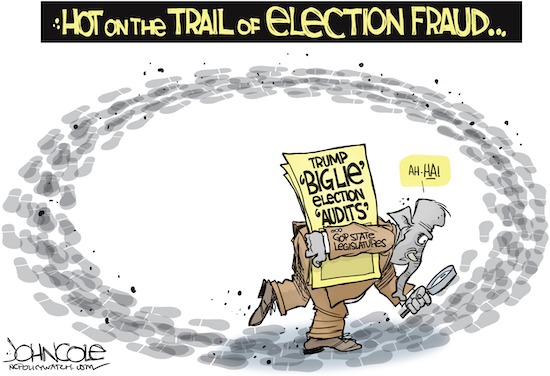
SB1040, sponsored by Mark Finchem (R-1), is a copy of a bill vetoed last year that would force county recorders to let anyone download voter registration rolls for free. Creating public, no-cost access to voter rolls enables spam and harassment, and allows bad actors to easily generate fake purge lists. This threatens the integrity of our elections. Scheduled for House Federalism, Military Affairs & Elections Committee, Wednesday. OPPOSE.
🐟 SB1057, sponsored by Mark Finchem (R-1), is an exact copy of a bill vetoed last year that would require ballot paper to include specific "anti-fraud countermeasures." This not only adds unnecessary complexity and expense to our elections, it's corruption in action. The bill is written so narrowly that only one vendor is qualified: Authentix, a company with ties to Finchem. As one critic says, this “reeks of being a shady backroom deal.” Scheduled for House Federalism, Military Affairs & Elections Committee, Wednesday. OPPOSE.
🐟 SB1060, sponsored by Wendy Rogers (R-7), is an exact copy of a bill vetoed last year that would ban US citizens from registering to vote in Arizona if they have a parent who is a US citizen and who is registered to vote in Arizona, but they themselves have never lived in the US. Banning citizens from voting is clearly unconstitutional. This is part of a national Republican push to disenfranchise voters in the name of “election integrity.” Scheduled for House Federalism, Military Affairs & Elections Committee, Wednesday. OPPOSE.
SB1237, sponsored by John Kavanagh (R-3), would require Arizona's secretary of state to consult with county recorders and the chairs and ranking members of the legislature's elections committees before creating Arizona's election procedures manual. Published every two years, the manual details procedures for county elections officials and carries the force of law. It must be approved by the governor and attorney general, both currently Democrats. This politically motivated bill is spurred by Republican sour grapes over Arizona voters electing Democrats as our top statewide officials, and comes after two years of failed lawsuits in which Republicans tried and failed to impose their own views on the manual. Scheduled for House Federalism, Military Affairs & Elections Committee, Wednesday. OPPOSE.

2026 Session Timeline
Friday 3/27: Last day for a bill to get out of committees in its crossover house
(and the last day to use RTS until a budget drops)
Tuesday 4/21: 100th Day of Session (the stated end goal; can be changed)
Tuesday 6/30: Last day to pass a constitutionally mandated state budget
Committees & Contacts
Here's a handy list of lawmaker contact info, committee chairs and assignments.
CEBV Action Linktree
Want other ways to take action? Need to stay informed? Looking for our social media, inspiration, or self-care tips? Look no further than our Linktree.
- Okay, it's us.
- There's still a chance our lawmakers will cook up some legislative shenanigans. A striker (strike-everything amendment) in a committee hearing can bring us brand-new language, as can a motion for lawmakers to waive their own rules so they can introduce a new bill. These are the exceptions, not the rule, but it's still true that no idea is truly dead until the legislature adjourns for good.
- State budget negotiations typically take place behind closed doors, in small groups that aren’t subject to the state’s open meeting laws. Once a deal with sufficient votes for passage is reached, it is voted on as swiftly as possible, with very little opportunity for public input or lawmaker dissent. Votes continue in the middle of the night and through the weekend until enough lawmakers are strong-armed and all bills are passed. Capitol observers had hopes that this would change under Gov. Hobbs, but unfortunately, that hasn’t been the case.
Congratulations, you made it to the end! 🎉 We'll leave you with an eyebrow-raising fact we learned this week: Justin Wilmeth (R-2) is a former child actor who appeared in the music video for Phil Collins' 1990 song "Do You Remember?" We were compelled to go look; here it is in case you'd like to watch too.

Comments ()